Can Americans Buy Property in Mexico? The 2026 Guide for Beachfront & Surf Buyers
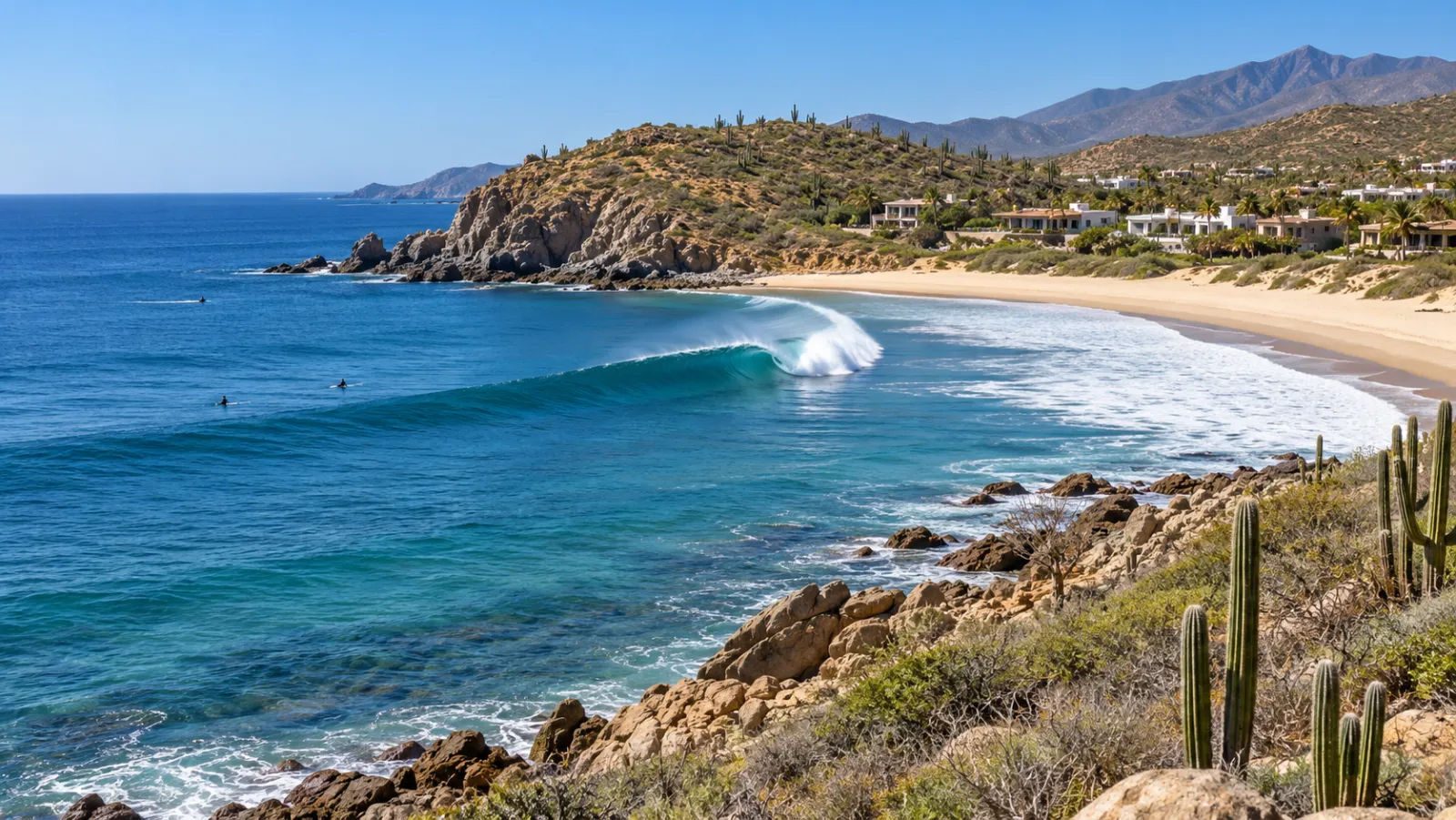
If you have ever sat in the lineup at a Mexican point break, looked back at the beach and wondered, "can Americans buy property in Mexico?", you are far from the only one. It is one of the most common questions we get from US surfers and beach buyers. The short answer is yes, and it is a well-worn path. But the way you hold title near the coast works differently from anything you know in the US, and knowing those rules before you fall for a place will save you money and stress.
The short answer: Yes. US citizens can legally buy property in Mexico. Inland, you can hold title directly in your own name. Within 50 km of the coast or 100 km of a border (the "restricted zone"), you hold residential property through a fideicomiso, a bank trust where you are the beneficiary with full rights to use, rent, sell and pass on the property.
This guide goes deeper than our shorter explainer on buying surf property in Mexico. It is written for Americans specifically: the legal basis, land versus houses, the traps (ejido land and the federal beach zone), a step-by-step purchase process, closing costs, financing, taxes on both sides of the border, and notes on the main surf regions.
Not legal or tax advice. This article is general information for education only. Mexican property law and tax rules change, and they apply differently depending on your situation. Before you sign anything or send money, hire an independent Mexican real estate attorney and work with a notario público, and talk to a cross-border tax professional.
Table of contents
The legal answer: Article 27 and the restricted zone
Mexico's rules on foreign ownership start with Article 27 of the Mexican Constitution. It says ownership of land and water within Mexico belongs originally to the Nation, and it bars foreigners from holding direct title to land in a strip along the borders and coasts. The Foreign Investment Law (Ley de Inversión Extranjera) puts numbers on that strip. Article 10 defines the restricted zone as the band of national territory 100 km along the borders and 50 km along the beaches (Ley de Inversión Extranjera, Orden Jurídico Nacional). That is roughly 62 miles and 31 miles.
For surf buyers the practical result is simple: almost every property you would actually want to surf from is inside the restricted zone.
The same law contains a workaround that has been used for decades. Foreigners can't hold direct title in the zone, but a Mexican bank can hold it in trust for them. Mexico's own consular service explains it plainly: in the restricted zone, "the bank will retain the property title but the foreigner is the beneficiary," and the beneficiary can "use and enjoy such premises and may sell or even inherit the rights to it" (Consulate of Mexico, Secretaría de Relaciones Exteriores).
The Calvo clause: what you agree to
Whatever structure you use, the foreign buyer signs an agreement with Mexico's Ministry of Foreign Affairs (SRE). You agree to be treated as a Mexican national with respect to that property and not to ask your own government to intervene on your behalf. The penalty for breaking that promise is losing the property to the Nation. This is known as the Calvo clause. It sounds dramatic, but it is a standard part of every foreign purchase and has nothing to do with your citizenship. In practice it means property disputes go through Mexican courts, not the US State Department. That is one more reason to get the due diligence right up front.
Three ways Americans can hold Mexican property
1. Direct Ownership — Escritura Pública
Outside the Restricted Zone, an American can generally acquire Mexican real estate directly in their own name. The transaction is formalized before a Mexican Notario Público and recorded in the appropriate Public Registry of Property. Foreign purchasers must comply with the requirements of Article 27, including the applicable agreement with Mexico's Ministry of Foreign Affairs. Ventana Única
This is the closest equivalent to conventional direct property ownership in the United States.
2. Bank Trust — Fideicomiso
For an American purchasing residential property within the Restricted Zone, the standard structure is a Mexican bank trust known as a fideicomiso.
The Mexican bank serves as trustee and holds title, while the American buyer is named beneficiary of the trust. The beneficiary has extensive rights to use and enjoy the property and may sell, transfer, lease, improve, or pass the beneficial interest to heirs, subject to the trust documents and Mexican law. Mexican government guidance specifically confirms that a foreign beneficiary may use and enjoy the property and sell or inherit the trust rights. Consulado Mexicano
The trust can run for up to 50 years and may be renewed. Portales SRE
For ISP, this is particularly important because it is the structure Americans will encounter with many beach homes, surf villas, condos and residential lots along Mexico's coastline.
3. Mexican Corporation
An American can also establish or participate in a Mexican corporation that owns Mexican real estate.
This structure becomes especially relevant for commercial and investment properties. Under Mexico's Foreign Investment Law, a Mexican company with foreign participation can directly acquire property within the Restricted Zone when the property is devoted to non-residential purposes, subject to the required notice to the Ministry of Foreign Affairs.
The Foreign Investment Law allows Mexican companies, including ones fully owned by foreigners, to acquire restricted-zone real estate for non-residential purposes, provided they notify the SRE within 60 business days of the acquisition (Ley de Inversión Extranjera, Art. 10). The US law firm Fredrikson & Byron summarizes the same point: a 100% foreign-owned Mexican corporation can own commercial property in the restricted zone directly, without a trust (Fredrikson & Byron, "Sun, Sand and Caveat Emptor").
A common mistake: using a corporation to hold a vacation home because it seems cheaper than a trust. A corporation that holds residential property for its owners' personal use doesn't fit the non-residential rule, and it comes with accounting and tax filing duties that often cost more than a trust fee. Unless you are really running a business, such as a surf camp, boutique hotel or multi-unit rental operation, the fideicomiso is usually the right tool.
How the fideicomiso works
A fideicomiso is a contract between three parties: the seller (who transfers the property into the trust), a Mexican bank (the trustee, fiduciario), and you (the beneficiary, fideicomisario). Here are the points that matter to an American buyer:
You control the property. You can live in it, remodel it, rent it out, sell your beneficiary rights, or mortgage it where a lender allows. The bank acts only on your written instructions.
It is not a lease. The trust term is up to 50 years and can be renewed at your request (Ley de Inversión Extranjera, Art. 13). It is not a countdown to losing your home. The team at International Surf Properties have many clients, friends and family that have renewed their fideicomiso leases with no issues whatsoever.
Estate planning is built in. You name substitute beneficiaries in the trust deed. When you die, the bank can transfer your rights to them without Mexican probate, which is one of the underrated benefits of the structure.
It is not a bank asset. The property sits in trust and doesn't form part of the bank's balance sheet. If the bank is merged or sold, the trust moves with it.
The bank needs an SRE permit. Before the trust is set up, the bank obtains a permit from the SRE. The law sets a short statutory window for the SRE to respond, and the permit counts as granted if no denial is issued in that window (Ley de Inversión Extranjera, Art. 10-A). Your notario and bank handle this, not you.
We cover the basics in more detail in our Mexico surf property explainer, so we won't repeat them here. The key point for this guide is that buying a house in Mexico as an American within sight of the ocean almost always means a fideicomiso, and that is a normal, well-tested structure used by many thousands of foreign owners.
Can Americans own land in Mexico? Land vs. houses
Yes. Americans can own land in Mexico under the same rules as houses: direct title inland, a fideicomiso in the restricted zone for residential use, or a Mexican corporation for commercial projects. The law doesn't distinguish between a finished villa and a vacant lot. What changes is how much can go wrong.
Buying land in Mexico carries more risk than buying a finished home for a few reasons:
Title history is often thinner. A condo in an established development usually sits on land that has been surveyed, subdivided, registered and sold several times. A rural beachfront parcel might have one or two recorded transfers, or none.
Boundaries may not match reality. Get a new survey (deslinde) and compare it with the cadastral record and the registered deed. Fences on the ground are not evidence.
Utilities and access aren't guaranteed. Confirm road access (and whether the road crosses someone else's land), water rights, a CFE electricity connection, and septic or sewer options before you pay.
Zoning and environmental permits. Coastal land may fall under municipal development plans, protected areas, or environmental impact rules that limit what you can build and how close to the beach.
Origin of the land. Much of Mexico's rural coast was, or still is, ejido land. That is the single biggest issue for land buyers, so it gets its own section.
Ejido land: the biggest risk on the coast
After the Mexican Revolution, large areas of rural land were granted to communities as ejidos: communal agrarian land governed by agrarian law rather than normal civil property law. Ejido members (ejidatarios) hold use rights, but the land can't simply be sold to an outsider, and a foreigner can't acquire ejido land as such.
Ejido land can become private property through a formal process in which the parcel converts to dominio pleno (full ownership). That involves an ejido assembly vote, registration with the Registro Agrario Nacional (RAN), issuance of a private title, and recording in the state Public Property Registry. Only after that is complete can the land legally go into a fideicomiso for a foreign buyer.
The risk is in the shortcuts. Fredrikson & Byron warn that "horror stories abound about buyers purchasing ejido land" and later having the ejido dispute the sale (Fredrikson & Byron). We see the same patterns come up again and again:
"The title is being processed, you can pay now."
A "cession of rights" (cesión de derechos) contract offered in place of a notarized deed.
A price well below comparable titled lots nearby.
A seller who insists a fideicomiso "isn't needed here."
The rule: if the property can't go into a fideicomiso and be recorded in the Public Registry at closing, you aren't buying property. You are buying a problem. Your attorney should check both the RAN and the Public Registry.
ZOFEMAT: the first 20 meters of beach belong to the nation
Even titled, trust-held beachfront property doesn't reach the water. Mexico's Zona Federal Marítimo Terrestre (ZOFEMAT) is "the 20-meter-wide strip of firm, passable land adjacent to the beach," and it is federal property (PROFEPA, Government of Mexico). SEMARNAT administers the zone and PROFEPA enforces the rules.
What this means for a beachfront buyer:
Beaches are public. You can't block access to the sand or the ZOFEMAT strip in front of your home.
Private use needs a concession. Putting anything permanent in the zone, such as a deck, pool, palapa, stairs or beach furniture set-up, requires a federal concession from SEMARNAT. A concession gives you rights of use only. It is not ownership, and it carries annual fees.
Check what you're buying. Ask whether the seller holds a ZOFEMAT concession, whether it is current and transferable, and whether any existing structures sit inside the zone without one. Unpermitted structures in the federal zone can lead to fines or orders to remove them.
On eroding coastlines the line itself can move, so ask your attorney to compare the official ZOFEMAT survey with the property's recorded boundaries.
How to buy property in Mexico as an American: step by step
The process is well established, but it runs through a notario público, a very different role from a US notary. A Mexican notario is a senior attorney appointed by the state who drafts and certifies the deed, confirms the taxes are paid, and registers the sale. The notario is neutral and doesn't represent you, which is why you also want your own attorney.
Here is how a typical restricted-zone purchase unfolds:
Set a budget that includes closing costs. Plan for closing costs on top of the purchase price (see below), plus a buffer for currency moves if you are paying in pesos.
Hire an independent Mexican real estate attorney. Pick someone who doesn't work for the developer or the seller's agent. The US Embassy advises that before starting a real estate purchase, US citizens should consult a Mexican attorney about the rules that govern property (U.S. Embassy & Consulates in Mexico).
Make an offer and sign a promissory agreement (contrato de promesa). This sets the price, deposit, conditions (title, permits, financing), timeline and who pays which closing costs. Have your attorney review it before you sign.
Put the deposit in escrow. Use a reputable US or Mexican escrow service, not the seller's personal account.
Title search and due diligence. Your attorney and the notario obtain a certificate of no liens (certificado de libertad de gravámenes) from the Public Registry. They also confirm the chain of title, check for ejido origin, and verify that property tax (predial), water bills and any HOA fees are up to date. Mexico's consular guidance stresses confirming that the property is free of mortgages and that its taxes are paid (Consulate of Mexico, SRE).
Choose a trustee bank and apply for the fideicomiso. The bank does its own know-your-customer checks and applies to the SRE for the trust permit.
Order the appraisal (avalúo). A certified appraiser values the property. The avalúo, together with the sale price and cadastral value, sets the base for the acquisition tax.
Get a new survey and check the ZOFEMAT position for any beachfront lot.
Consider title insurance. It is available from some US title insurers for Mexican property. Read what is covered and where claims are handled.
Sign the deed at the notario's office. The seller, the bank (as trustee) and you (or your representative under a power of attorney) sign the public deed (escritura). The balance is released from escrow.
The notario pays taxes and records the deed in the Public Property Registry. Recording can take weeks to months. You receive a certified copy once it is done.
After closing, put the utilities and predial account in order, register with the HOA if there is one, and keep a copy of the trust deed with your substitute beneficiaries.
From offer to signing, a clean resale commonly takes somewhere around 30 to 90 days. Land deals, new developments and anything involving ejido regularization can take much longer.
Closing costs and ongoing costs
Closing costs in Mexico are mostly paid by the buyer and vary by state, municipality, price and structure. Treat the figures below as typical ranges, not quotes. Your notario will give you a written estimate.
Typical Closing Costs When Buying Property in Mexico
Closing costs in Mexico are mostly paid by the buyer and vary by state, municipality, purchase price and ownership structure. Treat the figures below as typical ranges rather than quotes. Your Notario Público and attorney should provide a written estimate for your specific transaction.
Acquisition Tax (ISAI): Approximately 2%–5%
The acquisition tax is established under state and local law. The applicable taxable value may be based on the purchase price, appraisal or cadastral value, depending on local rules. Rates vary considerably by location.
Notario Público Fees: Approximately 0.5%–2%
Notario fees vary according to the property value and transaction. The percentage generally decreases as the property value increases. Request a written estimate before closing.
Fideicomiso Setup: Often US$1,500–$3,000+
For foreign buyers purchasing residential property within Mexico's Restricted Zone, initial fideicomiso expenses can include the bank's setup fee and government permit-related costs. Fees vary by bank and transaction.
Appraisal, Certificates & Registry Fees: Several Hundred to a Few Thousand US Dollars
These expenses can include the official appraisal (avalúo), lien or no-encumbrance certificates, other required certificates and Public Registry recording fees.
Independent Attorney: Flat Fee or Percentage
Attorney fees depend on the complexity and value of the transaction. Buyers should agree on the attorney's scope of work and fee in writing before proceeding.
Escrow & Title Insurance: Varies
Depending on the transaction, buyers may choose third-party escrow and/or title insurance for additional protection. Costs vary according to the provider, purchase price and services selected.
How Much Should You Budget for Closing?
As a general planning guideline, many buyers budget approximately 4%–8% of the purchase price for closing costs. The percentage can be higher on lower-priced properties because several transaction expenses are fixed fees rather than percentages.
Ongoing Ownership Costs
After closing, buyers should also budget for ongoing expenses. These can include the annual fideicomiso administration fee, predial (property tax), HOA dues where applicable, property insurance, maintenance and, for certain beachfront properties, applicable ZOFEMAT concession-related fees.
ISP Buyer Tip: Do not assume the advertised purchase price represents your total cash requirement at closing. Before removing contingencies or becoming fully committed to a purchase, ask your attorney and Notario Público for an itemized closing-cost estimate for the specific property.
All-in, many buyers budget roughly 4% to 8% of the purchase price for closing. The percentage tends to be higher on lower-priced properties, because several costs are flat fees.
Financing a Mexican beach home
Most American buyers in coastal Mexico pay cash, or use funds from a US home equity loan or portfolio. But cross-border mortgages do exist, where US-based lenders or Mexican banks finance restricted-zone property held in a fideicomiso. Typical terms need bigger down payments and cost more than a US mortgage. Some developers also offer short-term seller financing on new projects.
We've written a separate guide to financing Mexican beachfront property as a US buyer, covering lender types, down payments and how the trust fits into the loan.
Taxes: predial, rental income and capital gains
Property tax (predial)
Mexican property tax is municipal and is usually far lower than in most US states. It is calculated on the cadastral value, which is often well below market value. Many municipalities offer a discount for paying the full year early in the year. Your notario will confirm predial is current at closing. After that, it is on you.
Rental income
If you rent your beach house to surfers and vacationers, the income is taxable in Mexico wherever the money is paid. Under Article 158 of Mexico's Income Tax Law (LISR), non-residents who earn rental income from Mexican property pay 25% on gross income with no deductions, or can choose to pay 35% on net income after deductions (LISR Art. 158, SDV Asesores). Short-term rentals can also bring VAT and state lodging tax obligations. Platforms like Airbnb may withhold some of this. The rules have changed several times in recent years, so get a Mexican accountant (contador) before you list the property.
Capital gains when you sell
When you sell, Mexico taxes the gain. Non-residents generally choose between 25% of the gross sale price with no deductions, or 35% of the net gain after allowable costs, adjusted for inflation, which generally requires appointing a legal representative in Mexico (Mexperience). Keep every factura (official invoice) for improvements, because improvements without facturas generally can't be deducted. Mexican tax residents selling their primary home may qualify for an exemption on gain up to 700,000 UDIs (an inflation-indexed unit), subject to strict proof requirements. Most part-time American owners won't qualify.
On the US side
US citizens are taxed on worldwide income, so you will generally also report Mexican rental income and sale gains to the IRS. You may be able to claim a foreign tax credit for Mexican tax paid. Talk to a CPA who handles US-Mexico clients about reporting, depreciation and whether any additional forms apply to your trust structure.
Surf-region notes
The legal framework is the same across Mexico, but on-the-ground issues vary a lot by region. You can explore breaks across the country on our surf breaks map and see current listings on our Mexico page.
Baja California and Baja California Sur
Virtually every surf or beach property on the peninsula is inside the restricted zone, and the northern border strip adds to it, so trust ownership is standard. Northern Baja is the classic weekend-drive market for Southern Californians. Baja California Sur takes in the East Cape, the Cabo corridor and the Pacific-side towns around Todos Santos and Pescadero. In remote stretches, check road access, water supply and title history very carefully. Some well-known title disputes in Baja have involved land with contested origins, so a clean Public Registry history matters more than a view.
Nayarit: Sayulita, San Pancho and the Riviera Nayarit
This is one of the most established foreign-buyer markets in Mexico, with plenty of bilingual notarios, attorneys and trustee banks, and a deep resale market for condos and homes. Much of the rural land around these surf towns has ejido history, so for lots and houses outside established developments, confirm the conversion to dominio pleno and the registry record.
Oaxaca: Puerto Escondido and the southern coast
Puerto Escondido (home of the Mexican Pipeline), plus the surrounding points and beach breaks, has grown fast. The market is less mature, and ejido and communal land is common along this coast. Expect more of your due diligence to focus on land tenure and building permits. Prices and infrastructure vary a lot within a few kilometers.
Michoacán and Guerrero: La Saladita, Troncones and beyond
Long, mellow lefts like La Saladita and the Troncones area draw longboarders and families. These are smaller markets with fewer listings and fewer local professionals, and ejido-origin land is again a key issue. Check current US State Department travel advisories for these states as part of your planning, since conditions vary by area.
Across every region, the more remote and cheaper the parcel, the more due diligence it needs.
Red flags to walk away from
A seller or agent who tells you a fideicomiso "isn't necessary" in the restricted zone.
Being asked to wire money to a personal account instead of escrow or the notario.
"Cession of rights," "possession" or "ejido certificate" contracts in place of a notarized deed.
No certificate of no liens, or a seller who delays providing one.
Structures on the beach with no ZOFEMAT concession.
Pressure to close fast, or an attorney who "comes with" the seller or developer.
Presale developments with no permits you can check, or no escrow for deposits.
A price far below comparable titled properties nearby.
The US Embassy warns US citizens to be cautious about aggressive sales tactics and real estate and timeshare fraud in Mexico (U.S. Embassy & Consulates in Mexico). If something feels off, stop and have your own attorney look at it.
FAQ
Can a US citizen buy property in Mexico?
Yes. A US citizen can buy property anywhere in Mexico. Outside the restricted zone you can hold title directly in your name. Within 50 km of the coast or 100 km of a border, residential property is held through a fideicomiso (bank trust), with you as beneficiary.
Can Americans own beachfront property in Mexico?
Yes, through a fideicomiso or, for commercial use, a Mexican corporation. The first 20 meters of passable land next to the beach (the ZOFEMAT) remain federal, so no private owner, Mexican or foreign, owns the sand itself.
Can Americans own land in Mexico?
Yes, under the same rules as houses. The extra risks with land are title history, boundaries, access and utilities, and especially ejido land, which can't be sold to a foreigner until it has been converted to private (dominio pleno) property and recorded.
Is a fideicomiso safe?
It is a long-standing structure set out in Mexican federal law and used by many foreign owners. The bank acts only on your instructions, the property isn't a bank asset, and the trust can be renewed and passed to your named beneficiaries. As with any purchase, the real risks come from bad title or poor due diligence, not from the trust.
What happens when the 50-year fideicomiso term ends?
You can ask to renew it. The Foreign Investment Law provides that the term may be extended at the beneficiary's request. You can also sell your rights at any time during the term.
Do I need Mexican residency to buy property in Mexico?
No. You can buy on a tourist visit and hold the property from the US. Residency affects your tax position (for example, eligibility for the primary-home capital gains exemption), not your right to buy.
How much are closing costs when buying property in Mexico?
Many buyers budget roughly 4% to 8% of the price. That covers the state and municipal acquisition tax (often about 2% to 5%), notario fees, fideicomiso setup, appraisal and registry costs, plus your own attorney.
Can I rent out my Mexican beach house?
Yes, fideicomiso properties can be rented. The income is taxable in Mexico (non-residents generally pay 25% of gross or 35% of net under the Income Tax Law) and must be reported to the IRS. Check HOA rules and local short-term rental regulations too.
The bottom line
So, can Americans buy property in Mexico? Yes, and legally so, including the beachfront homes and surf-town lots most of our buyers are after. The fideicomiso does what direct title would do in the US, and the process is predictable when you follow it: an independent attorney, a proper title search, a notario-certified deed, a registered trust. The problems we see come from shortcuts: ejido parcels, unregistered "rights," structures in the federal beach zone, and deals that skip escrow.
If you are starting to look, browse Mexico surf and beachfront properties or all surf properties for sale on International Surf Properties, find your wave on the surf breaks map, and keep reading the ISP blog for more region and buying guides.
About the author
Jim Habig is the founder of International Surf Properties, a marketplace for surf-front and beachfront real estate around the world. A lifelong waterman and real estate professional, Jim started ISP to connect surfers and ocean lovers with homes and land near the waves they love, and to help them buy with clear, practical information. ISP is a listings marketplace, not a law firm; always work with independent local legal and tax professionals on any purchase.
Keep Reading
More From the Blog
 Buying & OwnershipBaja California
How to Sell Property Abroad as a US Owner: Taxes, Process and Timelines in Costa Rica, Mexico, Panama, Nicaragua and El Salvador
October 14, 2026
 Buying & Ownership
Wave Pool Homes: The 2026 Guide to Buying Real Estate in a Surf Park Community
October 11, 2026
 Buying & Ownership
Rosarito Real Estate: The 2026 Guide to Buying a Surf Home in Rosarito, Ensenada and Northern Baja
October 11, 2026