Popoyo, Nicaragua Real Estate: Buying on the Emerald Coast Surf Strip (2026 Guide)
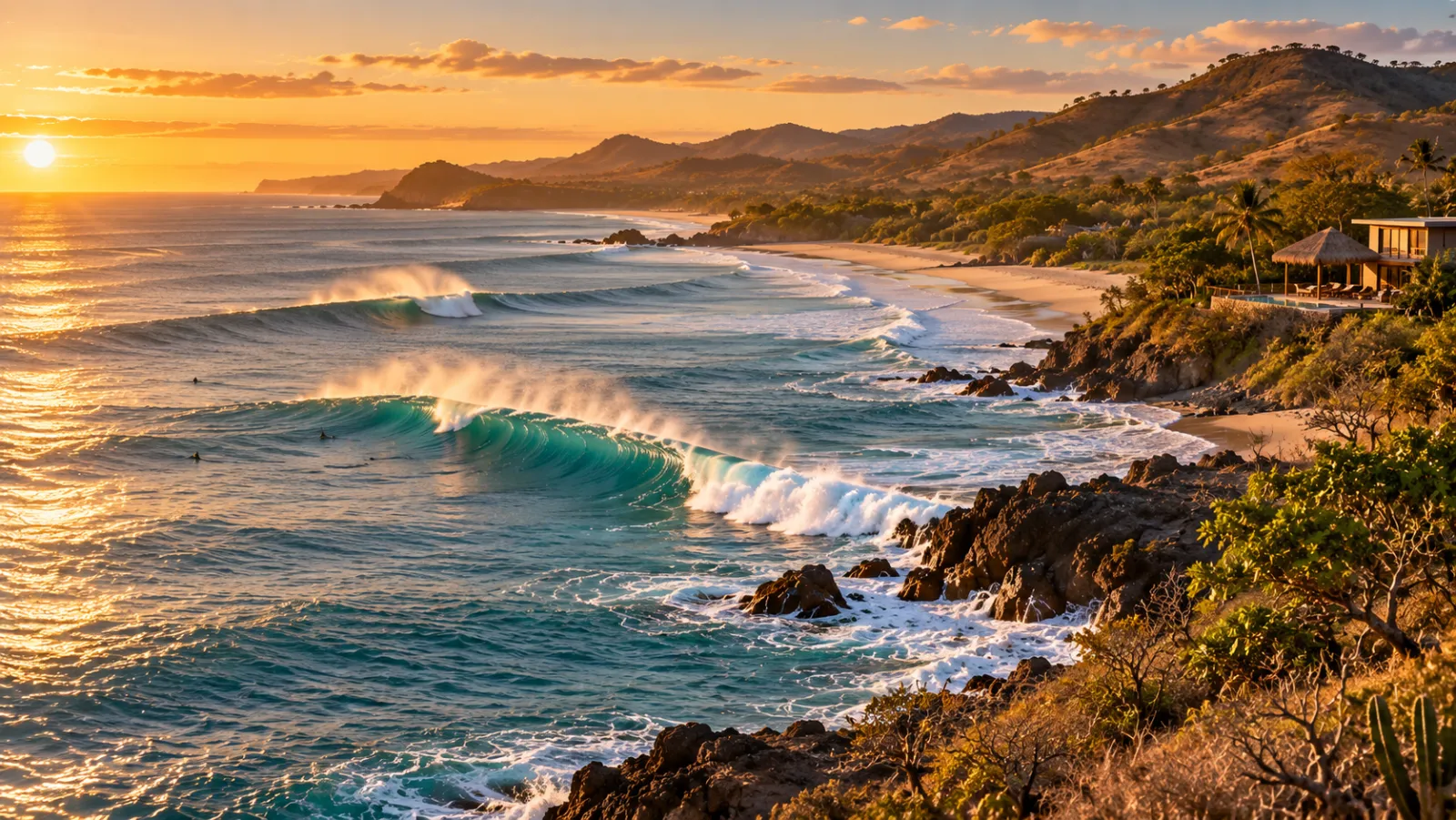
Popoyo real estate sits on one of the most consistent stretches of surf in Central America. Nicaragua's southwest coast, from El Astillero in the north to the beaches around San Juan del Sur, gets offshore winds off Lake Nicaragua for much of the year, and it packs reefs, beach breaks and points into a short drive. Land still costs a fraction of what comparable surf frontage costs across the border in Guanacaste. That combination has kept surfers buying here for two decades.
It also comes with real homework. Nicaragua has a strict coastal law, an unusual land-title history, a new border law that turned a 15 km strip into state property, and a 2026 political climate that the US State Department rates Level 3. This guide covers all of it, beach by beach and rule by rule.
Quick answer: Yes, foreigners, including Americans, can own titled land and homes around Popoyo in their own name or through a company. The first 50 meters above high tide are public, the next 200 meters are regulated, and title history must be checked back to 1979. Budget roughly 4% to 7% in closing costs and use an independent attorney.
Table of contents
Why Popoyo and the Emerald Coast draw surf buyers
The draw is the wind. Lake Nicaragua sits only 20 to 30 km inland from the Pacific along the Rivas isthmus, and the prevailing easterly trade winds blow across it and out to sea. On most mornings, and on many days all day, the Pacific coast of Tola and San Juan del Sur is groomed offshore. The dry season (roughly December to April) brings the strongest offshores, which can get too strong in the windiest months. The wet season (roughly May to November) brings the biggest south and southwest swells and lighter winds.
For a buyer, that means a surf house here gets used year round: the wet season for swell, the dry season for clean conditions and peak rental demand.
Access is the trade-off. Most buyers fly into Managua (MGA). From there Popoyo is roughly a 2.5 to 3 hour drive, and San Juan del Sur a little less. Liberia (LIR) in Costa Rica is another option, but it adds a land border crossing at Peñas Blancas. The small Costa Esmeralda airport near Rancho Santana, about 10 km from Popoyo, has had commercial service on and off and has been listed as closed; check its current status before you count on it.
The Emerald Coast surf strip, beach by beach
The "Emerald Coast" is a marketing name for the Pacific coast of Tola municipality in Rivas, but buyers tend to use it for the whole surf strip from El Astillero down to San Juan del Sur. Here is how it breaks down from north to south, plus the coast closer to Managua.
Masachapa, Montelimar and El Tránsito (closest to Managua)
Masachapa, Nicaragua and neighboring Pochomil and Montelimar sit about an hour from Managua, which makes them the weekend-beach market for the capital. The waves are more beach-break than reef, and the market is more Nicaraguan-owned than foreign. Further north in León department, El Tránsito has a handful of quality breaks and boutique surf-and-wellness stays such as Mandla. For a Nicaragua wellness retreat or small surf lodge within easy reach of the airport, this northern coast is worth a look.
El Astillero
El Astillero is a working fishing village at the northern end of the Emerald Coast, with a bay, beach breaks and reefs within a short drive or boat ride. It is quieter and less developed than Popoyo, so land tends to be cheaper and services thinner. Buyers looking for a surf camp in Astillero or a small surf resort in Astillero usually trade polish for space and fewer people in the water. Check road access carefully; some beachfront parcels are reached by dirt tracks that flood in the rains. North of the village, Playgrounds is a boat-access cobblestone break off the Chacocente Wildlife Refuge, about 25 minutes by panga from Astillero, and a regular day trip for Playgrounds Nicaragua surf seekers.
Popoyo and Guasacate
This is the center of the strip. Popoyo is a reef with a punchy A-frame that works on most swells, and the Outer Reef a short paddle out becomes a heavy big-wave spot on large south swells. The village behind it is Guasacate, and Guasacate beach runs north from the reef as a long sandy stretch with its own beach-break peaks. Some listings refer to part of the Guasacate area as La Jolla de Guasacate.
This is where most of the surf houses, small hotels and Popoyo land for sale are found. Expect everything from bare lots a few hundred meters back from the beach to finished surf houses and small hotels. Roads and power have improved, but water supply and septic still need checking lot by lot. See our Popoyo surf break page for the wave itself.
Playa Santana and Rancho Santana
Just south of Popoyo, Playa Santana is a beach break that picks up plenty of swell. Behind it sits Rancho Santana, a 2,700-acre private community with five beaches, including Playa Rosada, a reef with a left, and the beginner-friendly Playa Los Perros (Rancho Santana). It is the most developed and priciest address on the coast, with a hotel, club facilities and managed homes. Buyers searching for Rancho Santana lots for sale should expect developer pricing, HOA rules and architectural review, and in return get roads, power, water and security that are rare elsewhere.
Playa Colorado and Hacienda Iguana: Colorados and Panga Drops
Hacienda Iguana is a gated community of roughly 345 acres behind Playa Colorado, with a 9-hole golf course, two river mouths and about two and a half kilometers of beach. It fronts two of the best-known waves on the coast:
Colorados: a fast, hollow beach break near the river mouth, one of the most consistent barrels in the country. See our Colorados surf break page.
Panga Drops: an offshore reef that holds size and is reached by a long paddle or by boat. It is one of the best-known waves on the coast, which is why several operators market a surf camp at Panga Drops or a surf resort at Panga Drops.
Hacienda Iguana real estate runs from lots to beachfront homes. Owners pay HOA dues for security, roads and common areas. That makes it the simplest place on the coast to own a home you only visit a few times a year, and a good base for a rental.
Gigante and Redonda Bay
Further south, past Playa Amarillo, Playa Gigante is a small fishing village with its own points, and Redonda Bay (Playa Redonda), just south of Gigante, is a small bay with a few resorts and residential lots.
Playa Maderas, Remanso and Playa Hermosa (San Juan del Sur)
About 45 minutes to an hour south by road, San Juan del Sur is the region's town, with restaurants, supermarkets, clinics and a bay. Playa Maderas, about 20 minutes north of town, is a consistent, often crowded beach break; surfing Maderas is a rite of passage, and many a surf trip to Maderas starts from San Juan del Sur. See our Playa Maderas page. South of town, Playa Remanso is a softer beach break for learners, and Playa Hermosa offers several peaks with more limited access.
The San Juan del Sur market has more resale homes, condos and hillside view lots, and more year-round residents, than the Tola coast. It also sits closer to the Costa Rica border, which matters for the border law covered below.
Popoyo real estate prices in 2026
Popoyo real estate is priced by distance to the waves, access, utilities and whether a lot is inside a managed community. The ranges below are indicative as of 2026, based on the kinds of properties that come to market along the strip. They are not appraisals, and individual properties vary widely.
| Property type | Where you find it | Indicative range (US$, 2026) | Main things to check |
|---|---|---|---|
| Small inland or walk-to-beach lot | Guasacate, Astillero, Gigante | Roughly $30,000 to $150,000 | Road access, water, power, title history |
| Ocean-view lot in a gated community | Hacienda Iguana, Rancho Santana | Roughly $100,000 to $400,000+ | HOA dues, build rules, developer track record |
| Beachfront lot | Guasacate, Colorados, Redonda Bay | Often $250,000 to $1,000,000+ | Coastal law zones, erosion, concessions |
| Two- to three-bedroom surf house | Popoyo, Maderas, San Juan del Sur | Roughly $200,000 to $600,000 | Permits, construction quality, rental history |
| Beachfront or luxury home | Rancho Santana, Hacienda Iguana | $750,000 to several million | Community fees, resale market |
| Small surf camp or boutique hotel | Popoyo, Astillero, Maderas | Roughly $400,000 to $2,000,000+ | Licenses, books, staff, water rights |
Lots inside managed communities cost more but come with roads, utilities and security solved. Raw land outside them is cheaper but costs time and money to make buildable. Resale is thin compared with Costa Rica, so plan to hold for years.
If you are comparing across the border, our guides to buying property in Costa Rica and Costa Rica surf resorts and hotels for sale give a sense of the price gap.
Can Americans buy property in Nicaragua?
Yes. Nicaraguan law treats foreign buyers much like nationals. There is no bank-trust requirement like Mexico's fideicomiso, and no general ban on foreigners owning beachfront land. You can hold title in your own name, or through a Nicaraguan company (a sociedad anónima), which is common for rental businesses, hotels and surf camps. There is also no residency requirement to buy.
The limits that do exist apply to everyone, Nicaraguan or foreign:
The coastal public zone. No one can own the beach or the first 50 meters above high tide (see the next section).
The border zone. A new Border Territory Law approved on August 5, 2025 declared a 15 km strip along Nicaragua's borders to be state property, replacing the 2010 border law that only made the first 5 km inalienable (swissinfo/EFE). Popoyo, Hacienda Iguana and Rancho Santana are well outside that strip. Beaches in the far south of Rivas, near the Costa Rica border, may not be. Have a surveyor measure the distance for any parcel south of San Juan del Sur, and do not rely on older guides that describe a 5 to 15 km "waiver" process.
Communal and Indigenous land on the Caribbean coast follows its own regime under Law 445 and generally can't be sold to outsiders.
The coastal law: 50 meters public, 200 meters restricted
Nicaragua's Law 690, the Law for the Development of Coastal Zones (2009), sets out who can use the shoreline and how (Law 690, National Assembly of Nicaragua). Article 19 creates two bands on the ocean coast:
| Zone | Where it runs | What it means for a buyer |
|---|---|---|
| Public-use zone | The intertidal beach plus 50 meters inland from the average high-tide mark | State property. No homes or residences may be built, no fences or walls that block access, free public use of the beach |
| Restricted-use zone | The next 200 meters inland | The state exercises control, except for legally acquired rights and established towns; uses follow the coastal development plan, and permanent tourism buildings are allowed with permits |
| Beyond 250 meters | Everything further inland | Ordinary private property, subject to municipal and environmental permits |
Legally acquired rights are respected. Article 4 protects titles held legally before the law, so a properly registered beachfront parcel doesn't simply vanish. But the first 50 meters still can't be built on for housing, and anything close to the water will face tighter permitting.
Access must stay open. Articles 24 and 25 guarantee free access to the beach for nationals and foreigners and prohibit works that block it. Where no historic access exists, the law provides for a public path at least 10 meters wide. Large beachfront parcels can be required to give one up.
Concessions are limited. Use of the coastal zone is granted through municipal concessions that carry an annual fee, and Article 37 limits applications to Nicaraguans and foreign residents. A concession is a right of use, not ownership.
Ask your attorney and surveyor to plot the 50 m and 250 m lines on any beachfront lot before you agree a price. Two lots that both say "beachfront" in a listing can have very different buildable areas.
Title risk: confiscations, the registry and the cadastre
Title is the biggest property-specific risk in Nicaragua. During the 1980s the Sandinista government confiscated and redistributed thousands of properties through expropriations and agrarian reform, and many of those claims were never fully settled. Law 278 on reformed urban and agrarian property (1997) was meant to sort out who held what, but reform-era titles, overlapping claims and old indemnity cases still surface, especially on rural coastal land. More recently, land invasions by squatters have been a periodic issue on undeveloped parcels.
The US Embassy advises anyone buying property in Nicaragua to hire competent local counsel and investigate the property thoroughly (U.S. Embassy in Nicaragua). In practice that means your attorney should pull:
The registry history (historia registral) from the Public Property Registry, going back at least to 1979, to see whether the land was ever confiscated, reformed or indemnified.
A certificate of no liens (certificado de libertad de gravamen).
A cadastral certificate (certificado catastral) under the national cadastre law (Law 509), confirming the parcel's official boundaries and that the surveyed area matches the deed.
A new survey by a licensed surveyor, walked on the ground, compared with the cadastral map and neighbors' deeds.
Municipal tax solvency (solvencia municipal) showing property tax (IBI) is paid.
Confirmation there are no occupants, no pending lawsuits and no possession claims.
Title insurance is available in Nicaragua from some international insurers and is worth getting, especially on land. Read the exclusions. Some policies exclude government action, so title insurance is not protection against political seizure.
A few red flags are worth walking away from: a seller who offers "possession rights" (derechos posesorios) instead of a registered title, a deed that has never been recorded, a parcel with a reform-era origin and no clean chain since, or a price far below the lots next door.
Buying an island in Nicaragua
Searches for Nicaragua islands for sale and private island Nicaragua come in steadily, and a few islands do change hands. The rules are tighter than for mainland land.
Under Law 690, Article 6, islands formed by natural causes in the territorial sea or in inland waters, as far as the tides reach, are public domain, except those already in private ownership under the law. So a private island purchase depends on the island already having a valid, registered private title. On natural lakes and crater lagoons, and on islands larger than 2 square kilometers with a permanent settlement, the public shoreline strip is 5 meters rather than 50 (Article 19).
In practice, most privately owned islands are in Lake Nicaragua, particularly the small islets off Granada, where homes and a few lodges already sit on titled land. On the Caribbean side, the Corn Islands and the Pearl Cays fall within the autonomous regions, where communal land claims under Law 445 have led to long-running disputes over island sales. Pacific islands are few and small. If you see an island marketed as "for sale," start with the registry history and the Law 690 status before anything else.
Surf camps, surf ranches and resorts
A good share of buyers along this coast want a business: a surf camp near Playgrounds, a surf ranch in Popoyo, a small surf sanctuary in Nicaragua built around surf and yoga, or a small surf resort in Astillero where there is still room to build. Nicaragua lets foreigners own these outright, usually through a Nicaraguan company.
Buying an operating business adds checks beyond title:
Tourism registration with INTUR, the national tourism institute, plus municipal business licenses and health permits.
Environmental permits for the original construction and any expansion, especially inside the 250 m coastal band.
Water: a permitted well, or a reliable supply contract. Dry-season water is the hidden constraint on many Popoyo properties.
Labor liabilities: Nicaraguan employees accrue severance and benefits, and those follow the business.
Real books: bookings, occupancy and tax filings, not just a brochure. Travel volumes have swung with the political climate since 2018, so ask for several years.
Our guide to surf resorts for sale covers valuation in more depth; see current surf resorts, hotels and camps.
The political and travel climate in 2026
This part deserves plain language. Nicaragua has been governed by the same leadership for nearly two decades, and since the 2018 protests the government has closed thousands of NGOs and universities, stripped critics of citizenship and taken their property. As of September 2026, the US State Department rates Nicaragua Level 3: Reconsider Travel, reissued on May 14, 2026. The advisory cites crime, limited healthcare, wrongful detention and arbitrary enforcement of laws, and warns that authorities may seize property, including land, homes, cash and financial assets, without warning or legal justification (U.S. Department of State). It also notes that a constitutional change that took effect on January 16, 2026, prohibits dual nationality, and some Nicaraguan-Americans have lost their Nicaraguan citizenship.
On the ground, foreign owners along the Tola and San Juan del Sur coast have mostly continued to live, rent and sell, and the surf towns are calm day to day. The seizures that made headlines have mostly targeted government critics, NGOs, churches and universities rather than holiday-home owners. But there is little legal recourse when the state is on the other side, and no amount of due diligence removes that risk.
Sensible buyers here tend to:
Keep a low political profile and stay out of local politics, including on social media.
Size the purchase to money they can afford to have tied up in an illiquid, higher-risk market.
Keep proper title, tax and immigration paperwork current, because arbitrary enforcement starts with small lapses.
Enroll in the State Department's STEP program and reread the advisory before each trip.
Price the risk in. Part of the discount to Costa Rica is exactly this.
How a purchase works, step by step
Hire an independent attorney who does not work for the seller or developer. In Nicaragua, lawyers are also notaries, but you want one whose job is to protect you.
Sign a promise-to-sell agreement (promesa de venta) setting price, deposit, timeline, conditions and who pays which taxes and fees.
Put the deposit in escrow, not a personal account.
Title due diligence: registry history since 1979, no-liens certificate, cadastral certificate, survey, municipal solvency, occupant check.
Coastal and border check: plot the Law 690 zones on beachfront land and confirm the parcel is outside the 15 km border strip.
Permits and utilities: road access, water, power and, for land, what you can build.
Order title insurance if available for the parcel.
Sign the public deed (escritura pública) before the notary, pay the transfer taxes, then record the deed in the Public Property Registry and update the cadastre and municipal tax rolls.
Clean resales can close in 30 to 60 days. Recording and cadastral updates can take longer, and your purchase isn't complete until the deed is registered.
Closing costs and ongoing costs
These are typical ranges, not quotes. Your attorney should give you a written estimate.
| Cost | Typical range | Notes |
|---|---|---|
| Transfer tax (IR withholding on the transfer) | 1% to 7%, on a sliding scale by value | Set by the Tax Concertation Law (Law 822). It is legally a tax on the seller's gain, calculated on the higher of the deed price or cadastral value, but contracts often assign it to the buyer; negotiate it (Consortium Legal) |
| Registry fees | About 1% | Paid on recording the deed |
| Notary and legal fees | Roughly 1% to 2% | Agree a flat fee where possible |
| Survey, certificates, stamps | A few hundred to a couple of thousand US dollars | Cadastral certificate, survey, stamp duty |
| Title insurance and escrow | Varies | Recommended |
Many buyers budget roughly 4% to 7% of the price all in when the seller pays the transfer tax, and more when the buyer takes it on.
Ongoing costs are modest. The municipal property tax (IBI) is 1% of a taxable base set at 80% of the cadastral value, which is usually well below market value. Add HOA dues in communities such as Hacienda Iguana or Rancho Santana, insurance, property management, and a water and maintenance budget that takes salt air and rainy-season roads seriously. Rental income is taxed in Nicaragua under the same Law 822, and US owners must also report it to the IRS.
Frequently asked questions
Can Americans buy property in Nicaragua?
Yes. Americans can hold titled land and homes in their own name or through a Nicaraguan company, with no bank trust and no residency requirement. The limits are the same for everyone: the public beach zone, the 15 km border strip and communal lands on the Caribbean coast.
Is there Popoyo land for sale close to the waves?
Yes, though true beachfront is scarce and priced accordingly. Most land for sale in Popoyo, Nicaragua sits a few hundred meters back in Guasacate or on the surrounding hills. Check road access, water and title history, and plot the coastal law lines on anything near the sand.
What is Hacienda Iguana real estate like?
Hacienda Iguana is a gated community of about 345 acres behind Playa Colorado, with lots, homes and a 9-hole golf course. Owners pay HOA dues for security and roads. It fronts Colorados and Panga Drops, and boats run from the coast to remote breaks such as Playgrounds, so it suits buyers who want managed living right on the surf.
Are there Rancho Santana lots for sale?
Rancho Santana sells lots and homes directly and through resales. It is the most developed community on the coast, with its own beaches, hotel and services, and the highest prices. Expect architectural rules and HOA fees.
Can you own a beach house in Nicaragua on the sand?
Not on the sand itself. Under Law 690 the beach and the first 50 meters above high tide are state property where homes can't be built, and the next 200 meters are regulated. A Nicaragua beach house for sale will sit behind that line, or rely on rights acquired before the 2009 law.
Can you buy a private island in Nicaragua?
Only one that already has valid private title. Natural islands in the sea and inland waters are public domain under Law 690 unless they were already privately owned. Most titled islands are small islets in Lake Nicaragua near Granada.
Is it safe to buy property in Nicaragua in 2026?
It carries more political risk than most surf markets. The US State Department rates Nicaragua Level 3 and warns that authorities may seize property without legal justification. Many foreign owners on the Emerald Coast continue to live and rent there, but buyers should size their investment to that risk.
The bottom line
Popoyo real estate offers offshore winds most of the year, a dense mix of reefs and beach breaks from El Astillero to Maderas, and land that costs far less than comparable surf frontage in Costa Rica. Foreigners can own directly, without a bank trust. The risks are specific: the coastal law's 50 m and 200 m bands, title histories that run through the 1980s, the border strip in the far south, and a political climate that calls for a low profile and a measured stake.
If Nicaragua fits your plans, browse Nicaragua surf properties, compare lots and land and all surf properties for sale, or explore nearby waves on our surf breaks map. If you own a surf house, camp or lot on the Emerald Coast, you can list your property with us.
About the author
Jim Habig is the founder of International Surf Properties, a marketplace for surf-front and beachfront real estate around the world. A lifelong waterman and real estate professional, Jim started ISP to connect surfers and ocean lovers with homes and land near the waves they love, and to help them buy with clear, practical information. ISP is a listings marketplace, not a law firm; always work with independent local legal and tax professionals on any purchase.
Tags
Keep Reading
More From the Blog
 Buying & OwnershipBaja California
How to Sell Property Abroad as a US Owner: Taxes, Process and Timelines in Costa Rica, Mexico, Panama, Nicaragua and El Salvador
October 14, 2026
 Buying & Ownership
Wave Pool Homes: The 2026 Guide to Buying Real Estate in a Surf Park Community
October 11, 2026
 Buying & Ownership
Rosarito Real Estate: The 2026 Guide to Buying a Surf Home in Rosarito, Ensenada and Northern Baja
October 11, 2026