
Resorts for Sale in Costa Rica: A 2026 Buyer's Guide to Surf Hotels, Lodges and Eco-Lodges
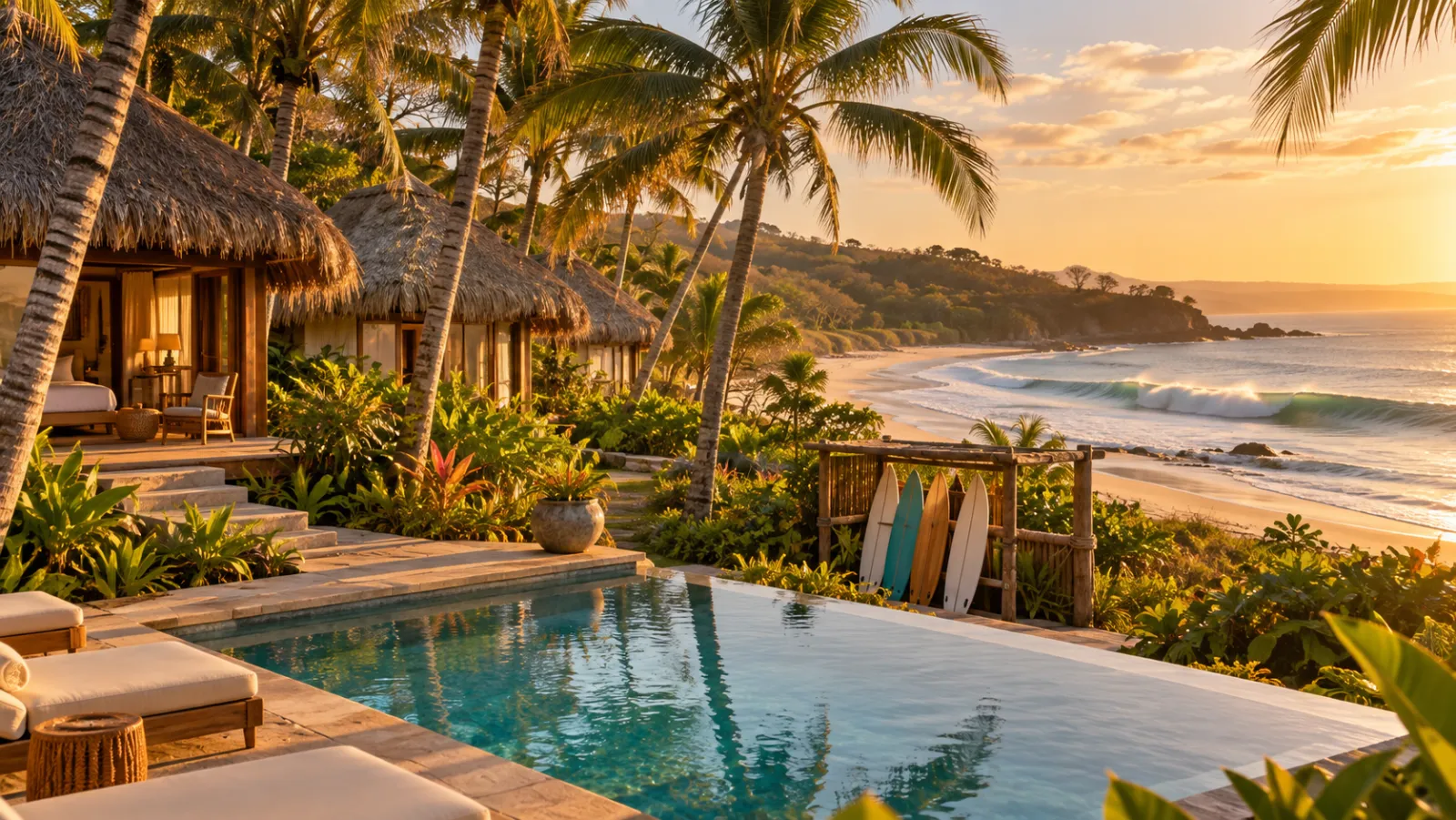
Every season we talk with surfers who have stayed at a small hotel near a good wave and started to wonder what it would take to own one. Searching for resorts for sale in Costa Rica is a sensible place to start. The country has year-round surf on two coasts, steady international arrivals and a deep bench of owner-operated surf hotels, lodges and eco-lodges. It also has hospitality-specific rules that catch buyers who treat a hotel like a beach house with extra bedrooms.
Quick answer: Foreigners can buy a surf resort or hotel in Costa Rica on the same terms as citizens, as long as the land is titled. Buy on verified net operating income, not the seller's story. Confirm the municipal business license, health permit, water rights and CCSS payroll status, and treat any beachfront land within 200 meters of high tide as a maritime zone concession until proven otherwise.
This guide is about buying an operating business. For the basics of foreign ownership, closing costs and property tax, read our companion guide to buying property in Costa Rica. We won't repeat those rules here.
Not legal or tax advice. This article is general information. Costa Rican tourism, labor, tax and environmental rules change and apply differently to each property. Before you sign or wire money, hire an independent Costa Rican attorney, a local accountant (contador) and, for larger deals, a hospitality consultant.
Table of contents
- What you are really buying
- Where to look for resorts for sale in Costa Rica, region by region
- How to value a surf hotel: ADR, occupancy, RevPAR and cap rates
- Licenses and permits a Costa Rica hotel needs
- The maritime zone problem for beachfront hotels
- Rainforest, waterfall and eco-lodge properties
- Share deal or asset deal, and how to finance it
- Due diligence checklist for a Costa Rica hotel purchase
- The alternative: surf vacation rentals and condo-hotels
- Frequently asked questions
- Final thoughts
What you are really buying
When you buy a hotel in Costa Rica you are usually buying three things at once:
- Real estate: the land and buildings, which may be titled property, maritime zone concession land, or a mix.
- A business: the reservations, reviews, booking channels, staff, supplier relationships and licenses.
- Liabilities: payroll obligations, tax filings, unpermitted structures and any disputes that come with the company or the site.
Most small surf hotels here are owned through a Costa Rican company (an S.A. or S.R.L.), which shapes how the deal is structured. Many have 6 to 25 rooms: bungalows, a pool, a breakfast area and a board rack. Large branded resorts are a different world of institutional buyers and management contracts. This guide focuses on the owner-operated surf hotel, surf camp, fishing lodge and eco-lodge, which is what most people mean when they search for Costa Rica resorts for sale.
Where to look for resorts for sale in Costa Rica, region by region
Location drives everything: your guests, your season, your staffing and what the land is worth if the business fails. Here is how we see each surf region as a hotel buyer.
| Region | Nearest international airport | Main waves | Hotel buyer profile | Key watch-outs |
|---|---|---|---|---|
| North Guanacaste (Liberia, Coco, Papagayo) | Liberia (LIR), 30 min to Coco | Witch's Rock, Ollie's Point (by boat) | Boat-trip surf camps, fishing, airport-corridor hotels | Surf is off-site; Papagayo winds; resort-pole concession land |
| Tamarindo, Avellanas, Playa Negra | LIR, roughly 1 to 1.5 hrs | Tamarindo, Playa Grande, Avellanas, Playa Negra | Most liquid market, surf schools, boutique hotels | Competition, water, Las Baulas park limits |
| Nosara | LIR, roughly 2 to 2.5 hrs | Playa Guiones | High-end wellness and surf retreats | Strict land-use rules, high entry prices, roads |
| Santa Teresa / Mal País | LIR by road or San José via ferry | Santa Teresa, Playa Hermosa (Nicoya) | Design-led boutique hotels, strong international demand | Water availability, permit history, dust and roads |
| Central Pacific (Jacó, Hermosa, Boca Barranca) | San José (SJO), about 1.5 hrs to Jacó | Playa Hermosa, Esterillos, Boca Barranca | Weekend and contest traffic, condos, budget surf hostels | Urban competition in Jacó, rivermouth water quality |
| Manuel Antonio / Quepos | SJO, about 2.5 to 3 hrs; Quepos airstrip | Beach breaks nearby, not the main draw | Wildlife and national park tourism, fishing | Steep lots, maritime zone, crowded hotel market |
| Dominical / Uvita | SJO, about 3.5 hrs | Dominical, Uvita area | Jungle-view surf lodges and eco-retreats | Steep access roads, landslides, water sources |
| South Pacific (Pavones, Osa) | SJO plus domestic flight to Golfito or Puerto Jiménez | Pavones, Matapalo | Remote surf camps and lodges | Title history, supply logistics, short trading history |
| Caribbean (Puerto Viejo) | SJO, about 4 to 5 hrs | Salsa Brava, Cocles, Punta Uva | Cabinas, backpacker and eco-lodges | Maritime zone and protected areas, Talamanca zoning |
Drive times are rough averages in the dry season and depend on the exact town and traffic.
North Guanacaste: the Liberia airport corridor
If you are searching for a resort for sale in Liberia, note that Liberia itself is an inland airport town whose hotels mostly serve business and transit stays. The beach resorts sit 30 to 60 minutes west, around Playas del Coco, Ocotal and the Papagayo Gulf. Part of the Papagayo Peninsula is a state-planned tourism project run on long-term concessions, so check the land regime before assuming anything is titled.
For surfers, this corridor means Witch's Rock (Roca Bruja), a beach break at Playa Naranjo inside Santa Rosa National Park, and Ollie's Point, a right point further north near the Nicaraguan border. Both are reached mainly by boat from Coco, Flamingo or Tamarindo, with park fees, hours and operator authorizations applying (Surf Atlas). A surf camp here sells boat days, not a wave out front, so its value depends on boats, captains and permits. Strong offshore Papagayo winds from roughly December to April groom Witch's Rock but make the ride out rough.
Tamarindo, Avellanas and Playa Negra
This is the most established surf hotel market in the country. Tamarindo has the depth of guests, restaurants and service providers that make a hotel easier to run, and Playa Grande sits just across the estuary. South of town, Playa Avellanas and the right reef at Playa Negra draw more dedicated surfers and support smaller, quieter surf hotels. Expect strong competition and plenty of comparable sales, which helps with valuation.
Nosara and Santa Teresa
Playa Guiones in Nosara is one of the most consistent beach breaks in Costa Rica, and the town has positioned itself around surf, yoga and wellness. Room rates can be among the highest on the coast, and so can entry prices. Santa Teresa has a similar international crowd with more nightlife. In both places, water supply and the permit history of every building are the checks that matter most.
Central Pacific: Jacó, Playa Hermosa and Boca Barranca
The Central Pacific is the closest surf to San José. Playa Hermosa is a heavy, consistent beach break that hosts contests, and Playa Esterillos is quieter to the south. North of Jacó, near the port town of Barranca and Puntarenas, Boca Barranca is a long left rivermouth that can run for hundreds of meters on a good south swell. Rivermouth water quality after rain is a known issue, so a hotel near Boca Barranca sells length of ride, not a postcard beach. Hotels in this region lean on weekend domestic travel as well as international guests.
Manuel Antonio and Quepos
Buyers searching for Manuel Antonio hotels for sale are usually after national park and wildlife tourism, with sport fishing out of Quepos and surf as a bonus. The hillside road from Quepos to the park is lined with small hotels, bungalow properties and ocean-view condo complexes. A bungalow property in Manuel Antonio can make a good small hotel, but lots are steep, drainage matters and some beachfront land is maritime zone. The area is home to the squirrel monkey (mono tití), and some condo and hotel projects use that name. If a condo complex runs a rental program, treat a unit there as a condo-hotel investment and read the condominium rules and rental agreement before relying on any income figures.
Dominical, Uvita and the South Pacific
Dominical and Uvita suit jungle-view surf lodges and eco-retreats, with the Marino Ballena National Park nearby. Further south, Pavones and Matapalo on the Osa Peninsula support small surf camps for dedicated surfers. These markets are thinner and land history is more complicated. Our Pavones real estate guide goes into the south in detail.
Caribbean: Puerto Viejo and Salsa Brava
Salsa Brava in Puerto Viejo is a shallow, powerful reef that breaks best on winter swells, roughly December to March. Playa Cocles and Punta Uva sit just south. The Caribbean's weather pattern differs from the Pacific's, with September and October often among its drier months. Much of the land close to the beach is maritime zone or protected area, so hotels here need very careful title and zoning work.
How to value a surf hotel: ADR, occupancy, RevPAR and cap rates
Sellers of small hotels often quote a price based on what they have put in, what the land is worth, or what they need to retire. Buyers should value the business on what it actually earns.
The four numbers to understand
- ADR (average daily rate): room revenue divided by rooms sold.
- Occupancy: rooms sold divided by rooms available.
- RevPAR (revenue per available room): ADR multiplied by occupancy. It shows how well the hotel turns its inventory into revenue.
- NOI (net operating income): total revenue minus all operating expenses, before debt payments and income tax. This is the number a cap rate is applied to.
The cap rate is NOI divided by price. A lower cap rate means you are paying more for each dollar of income.
A worked example
Here is a hypothetical 12-room surf hotel, using round numbers for illustration only:
- ADR of US$150 at 60% annual occupancy gives a RevPAR of US$90.
- 12 rooms × 365 nights × US$90 = about US$394,000 in room revenue.
- If operating expenses (staff, CCSS charges, utilities, OTA commissions, maintenance, insurance, marketing, taxes other than income tax) take 65% of revenue, NOI is roughly US$138,000.
- At a 10% cap rate, that business supports a price of about US$1.38 million. At 8%, about US$1.7 million.
The real work is testing each input. Two adjustments come up in almost every deal:
- Pay a manager. If the seller works 70 hours a week without a salary, NOI is overstated. Deduct the cost of a real manager.
- Normalize maintenance. Salt air and humidity wear out roofs, pumps and air conditioners fast. Deferred repairs inflate NOI, so budget an annual replacement reserve.
No reliable index publishes cap rates for small Costa Rica hotels, and they vary with location, title type and owner dependence. Buyers of owner-operated properties usually want a higher yield than on a US hotel to cover the extra risk. Be skeptical of any single "market cap rate," and treat land value as a floor.
Seasonality
The Pacific coast has a dry high season from roughly December to April and a green season from May to November, wettest in September and October. The green season also brings the best south swells, which is why surf hotels often hold up better in the rainy months than generic beach hotels. Ask for three years of month-by-month data.
For context, the Costa Rican Chamber of Hotels' survey for the 2025–26 high season projected about 77% average occupancy nationally, with beach hotels around 80%, the lowest outlook for that period since 2022 (The Tico Times). The ICT statistics portal publishes official arrival figures that help you gauge demand trends.
Sales tax on lodging
Lodging and tourism services in Costa Rica now carry the standard 13% value-added tax (IVA). ICT-registered businesses had a phase-in after the 2018 tax reform that reached the full rate in 2023. If a seller's historic rates were set during the phase-in, check that current pricing already absorbs the full tax.
Licenses and permits a Costa Rica hotel needs
A hotel that looks fine on booking sites can still be operating without some of its permits. Your attorney should confirm each of these is current and in the right name, and whether it transfers.
| Permit or registration | Issued by | What it covers | Transfers with a sale? |
|---|---|---|---|
| Municipal business license (patente comercial) | The municipality | The right to operate a business at that address | Usually needs a transfer or new application, especially in an asset deal |
| Health operating permit (permiso sanitario de funcionamiento) | Ministry of Health | Sanitary conditions for lodging and food service | Tied to the operator; renewed periodically |
| Liquor license (patente de licores) | The municipality | Alcohol sales at the bar or restaurant | Rules on transfer vary; check before you price it in |
| Tourism declaration (declaratoria turística) | ICT | Official recognition as a tourism business | Voluntary; linked to the company |
| Environmental clearance (viabilidad ambiental) | SETENA | Environmental approval for the project | Check the original file for any conditions |
| Water concession or utility letter | MINAE Dirección de Agua, AyA or local ASADA | Legal right to use well, spring or piped water | Wells and springs need a registered concession |
| Employer registration | CCSS (social security) and INS (work insurance) | Payroll contributions and workers' compensation | Liabilities can follow the business |
A few details matter here:
- The ICT tourism declaration is optional. It is a free, voluntary recognition that brings promotion and is required for a tourism contract, but carries no tax exemptions or liquor license, and applicants must be current with the CCSS (ICT). A declared hotel has had its documents reviewed by the ICT, which helps due diligence.
- The health permit is issued by the Ministry of Health according to the establishment's risk category (Ministerio de Salud). Kitchens, pools and wastewater are where problems tend to show up.
- Water. Using water from a well, spring or river for a productive use needs authorization from MINAE's Dirección de Agua (Dirección de Agua). Unregistered hotel wells are common and fixable, but a real risk in dry Guanacaste.
- CCSS and labor. Employer social charges run to roughly a quarter of gross payroll, before work insurance, the December bonus (aguinaldo) and severance. A change of owner generally doesn't end employment contracts, so accrued staff liabilities can pass to you. Get a CCSS certificate and a per-employee liabilities calculation.
The maritime zone problem for beachfront hotels
Many of the best-located surf hotels on the coast sit partly or wholly inside Costa Rica's 200-meter maritime zone. Under the Maritime Terrestrial Zone Law (Law 6043), the first 50 meters from high tide are public and can't be built on. The next 150 meters can only be held under a municipal concession, a fixed-term right of use, generally where an approved coastal zoning plan exists (Ley 6043, SNIT). In many tourism areas, the ICT also has a role in approving concessions.
For a hotel buyer, the practical consequences are:
- Foreign ownership limits. Foreigners with under five years of residency can't hold a concession directly, and companies more than 50% foreign-owned can't hold one. A foreign buyer can typically own a minority stake at most. Our Costa Rica buying guide explains Articles 47 and 48 in detail.
- Term risk. Concessions run up to 20 years and renewal isn't automatic. Value the income stream against the remaining term, not forever.
- Structures without a concession. Older hotels sometimes have rooms, a restaurant or a pool in the public zone or on land with no valid concession. Those can be ordered demolished, and your valuation should reflect it.
- Financing. Banks rarely lend against concession rights.
Use the rule as a filter. A hotel on titled land 250 meters back, with a path to the sand, is often far safer than one that "has the beach" on a concession you can't legally control.
Rainforest, waterfall and eco-lodge properties
Much of the interest in rainforest real estate in Costa Rica comes from buyers who want an eco-lodge, retreat or small eco village rather than a beach hotel. The hills behind Dominical, Uvita, Ojochal, Manuel Antonio and the Osa, and the Caribbean slope near Puerto Viejo, have rainforest properties with ocean views, rivers and sometimes a waterfall. Some of the best tropical resorts for sale in Costa Rica are small lodges like these.
Three legal points shape what you can do with that land:
- Water protection areas. Costa Rica's Forestry Law (Law 7575, Article 33) declares protection areas of 100 meters around permanent springs, and strips along rivers and streams: 15 meters in rural areas on flat land (10 meters in urban areas) and 50 meters where the terrain is steep (Ley Forestal 7575, SINAC). A property marketed as Costa Rica real estate with a waterfall almost always has a protection area around that waterfall and its stream. That limits where you can build. Parts of Article 33 have been amended in recent years, so have your attorney confirm the current rules for your site.
- Forest cover. Cutting forest for building sites is tightly restricted. Plan cabins and lodges within existing clearings, and check the permit history of any clearing that looks recent.
- Subdivision. An eco village for sale is usually a subdivision or condominium with shared land. Confirm that lots are legally segregated with their own cadastral plans, who owns roads and common areas, and how each lot gets water.
Budget for road upkeep, solar and batteries, water storage and 4x4 guest transport. These costs belong in the NOI.
Fishing lodges
A Costa Rica fishing lodge for sale is usually on the Pacific near Quepos, Golfito, the Osa, Flamingo or Los Sueños, or on the Caribbean near Barra del Colorado, a traditional tarpon and snook area inside a wildlife refuge. In these deals the boats, captains' licenses, fishing permits and marina slips can be worth as much as the rooms. Lodges inside refuges or national park buffers often have limited or unusual land rights, so the title review needs to start early.
Share deal or asset deal, and how to finance it
Share deal
Many sales transfer the shares of the owning company, which keeps permits, contracts, bank accounts and booking profiles in place. The catch is that you inherit the company's tax, labor and CCSS history. Share deals need a full corporate, tax and labor audit, seller indemnities and often a holdback from the price. Don't assume a share transfer avoids transfer tax; your attorney should confirm how it is treated.
Asset deal
Buying the land, buildings and equipment directly is cleaner for historic liabilities, but staff contracts can still transfer and licenses usually need reissuing in the new name. Plan a transition period while the seller's licenses stay active.
Financing
Most small hotel purchases are cash or seller-financed. Costa Rican banks make commercial hotel loans, but with large down payments, shorter terms and local financial statements. Seller financing also gives the seller a reason to support a smooth handover. Concession land is hard to finance at all.
Due diligence checklist for a Costa Rica hotel purchase
Use this as a starting point with your attorney and accountant:
Title and land
- Registro Nacional title report and cadastral plan for every parcel, checked against the ground.
- Where the 50 m and 200 m maritime zone lines fall, and copies of any concession and the coastal zoning plan.
- River and spring protection areas, national park and refuge boundaries.
- Legal access from a public road.
Permits
- Municipal business and liquor licenses, health permit, SETENA file, building permits for every structure, including later additions.
- Water: utility or ASADA letter, and Dirección de Agua concession for any well or spring.
- Wastewater system approval and capacity.
Financials
- Three years of monthly revenue by channel, reconciled to bank statements and tax returns.
- Booking engine and OTA reports showing ADR and occupancy by month.
- Payroll records, CCSS and INS certificates, accrued aguinaldo, vacation and severance per employee.
- Current IVA filings.
Operations and physical
- Building, roof, electrical and pool inspection by a local engineer.
- Equipment inventory, including boats, vehicles and surfboards if included.
- Supplier, OTA, management and lease contracts, and whether they transfer.
- Online reviews and reputation, which are part of what you are paying for.
Company (share deals)
- Corporate books, share register, beneficial ownership filings and legal-entity tax.
- Litigation searches against the company and the property.
The alternative: surf vacation rentals and condo-hotels
Not every buyer needs a licensed hotel. A Costa Rica beach house for sale in a surf town, or one of the ocean view homes for sale in Costa Rica's hills, rented to surfers online, delivers much of the lifestyle with less complexity. Costa Rica surf vacation rentals are common in Tamarindo, Nosara, Santa Teresa, Jacó and Dominical, all within reach of some of the most consistent Costa Rica waves.
A rental needs a cleaner and a property manager rather than a payrolled team, is financed and resold as residential property, and avoids most hotel licensing. A hotel can earn more but sells to a narrower pool of buyers.
Short-term rental income is taxable and lodging carries IVA, so involve a local accountant before you list. A condo in a complex with a hotel-style rental program sits in between: you own the unit, the operator runs it, and the rental agreement sets your share of revenue and costs. Browse surf vacation rentals and villas if this is the better fit, or search lots and land if you would rather build.
Frequently asked questions
Can a foreigner buy a surf resort in Costa Rica?
Yes. Foreigners have the same property rights as citizens on titled land, and can own a hotel directly or through a Costa Rican company. The main exception is maritime zone concession land within 200 meters of high tide, where foreign ownership is limited to a minority stake unless you meet the residency rules.
How much does a surf hotel in Costa Rica cost?
It depends on location, room count, land type and earnings. As an indicative range in 2026, small surf hostels and lodges in secondary towns can start in the high six figures, while established boutique hotels in Tamarindo, Nosara or Santa Teresa commonly reach several million US dollars. Value each one on verified NOI.
What licenses do you need to run a hotel in Costa Rica?
At minimum, a municipal business license (patente), a Ministry of Health operating permit, water rights, and CCSS and INS employer registration. A liquor license is needed for a bar. The ICT tourism declaration is voluntary but useful. Building permits and any SETENA approvals should cover every structure.
Is there a resort for sale in Liberia, Costa Rica?
Liberia itself has mostly airport and business hotels. The beach resorts in the Liberia airport corridor are around Playas del Coco, Hermosa, Ocotal and the Papagayo Gulf, 30 to 60 minutes away. Check whether Papagayo properties are titled or on the state tourism project's concessions.
Are Manuel Antonio hotels for sale a good investment?
Manuel Antonio's national park tourism supports demand beyond surfers. The trade-offs are steep lots, heavy competition and maritime zone issues on the beach. A titled hillside bungalow property with verified earnings is usually safer than a beachfront hotel on concession land.
Can I buy rainforest property with a waterfall in Costa Rica?
Yes, but the Forestry Law sets protection areas around springs, rivers and streams, so the waterfall and a strip around it generally can't be built on. Confirm buildable areas, water rights and legal access before you pay a premium for the view.
Is it better to buy a surf hotel or a vacation rental in Costa Rica?
A vacation rental is simpler to own, finance and resell. A hotel can earn more, but it is a full-time business with staff, licenses and payroll liabilities. If you don't plan to live on site or hire a strong manager, start with a rental.
Final thoughts
The right surf resort in Costa Rica combines a good wave, titled land, clean permits and earnings you can verify. Deals go wrong when one is missing: a concession treated as freehold, an unregistered well, uncounted payroll liabilities, or a price set on the seller's hopes. Whether it's a surf hotel or any other hotel in Costa Rica for sale, do these checks with your own attorney and accountant.
When you are ready to look, browse hotels, surf resorts and camps for sale, see everything on our Costa Rica page or across all listings, and read our wider guide to surf resorts for sale around the world. If you own a hotel you are thinking of selling, you can list your property or contact us.
About the author
Jim Habig is the founder of International Surf Properties, a marketplace for surf-front and beachfront real estate around the world. A lifelong waterman and real estate professional, Jim started ISP to connect surfers and ocean lovers with homes, land and hospitality properties near the waves they love, and to help them buy with clear, practical information. ISP is a listings marketplace, not a law firm; always work with independent local legal and tax professionals on any purchase.
Keep Reading
More From the Blog
 Buying & OwnershipBaja California
How to Sell Property Abroad as a US Owner: Taxes, Process and Timelines in Costa Rica, Mexico, Panama, Nicaragua and El Salvador
October 14, 2026
 Buying & Ownership
Wave Pool Homes: The 2026 Guide to Buying Real Estate in a Surf Park Community
October 11, 2026
 Buying & Ownership
Rosarito Real Estate: The 2026 Guide to Buying a Surf Home in Rosarito, Ensenada and Northern Baja
October 11, 2026