El Salvador Beach Real Estate: Houses, Land & Investment Property on the Surf Coast (2026 Guide)
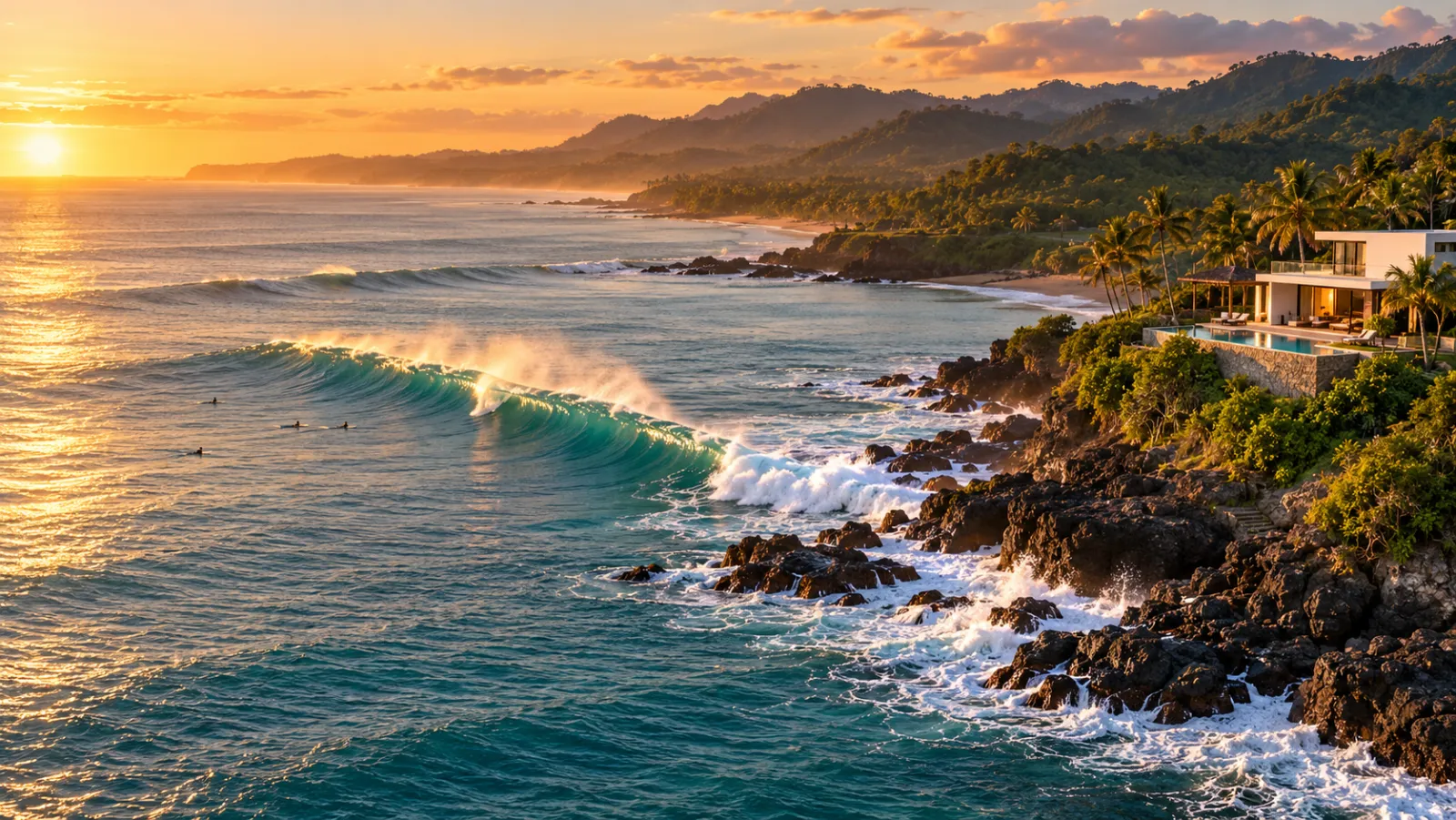
Ten years ago, El Salvador beach real estate was a niche interest for surfers who kept coming back to the right-hand points of La Libertad. In 2026 it is one of the most searched beach markets in Central America. The country uses the US dollar, most of the main surf coast is under an hour from the international airport, and security has changed sharply. That has pulled in buyers looking for a surf house, a rental investment or land near the waves. It has also pushed prices up fast and brought in plenty of new sellers, some more careful than others.
Quick answer: Foreigners can generally buy El Salvador beach real estate in their own name, with the same rights as Salvadorans. Rural land is subject to a reciprocity rule, so have your notary confirm your nationality qualifies. Deals close before a notary and are recorded at the CNR registry. Budget 3% transfer tax on value above US$28,571.43, plus fees.
Not legal or tax advice. This article is general information only. Salvadoran property and tax rules change and apply differently to each buyer. Before you sign anything or send money, hire an independent Salvadoran attorney-notary and talk to a tax professional in El Salvador and your home country.
Table of contents
- Why El Salvador beach real estate is on buyers' radar
- Can foreigners buy property in El Salvador?
- The three surf coasts compared
- Surf City: El Tunco to Mizata
- The eastern surf coast: Las Flores, Punta Mango and El Cuco
- Costa del Sol, El Pimental and the Sonsonate coast
- Houses, condos, land and luxury homes: what's for sale
- How to buy property in El Salvador step by step
- Closing costs and taxes
- Investment beach property: rental and Airbnb realities
- Bitcoin, security and the new airport
- Red flags to walk away from
- Frequently asked questions
- The bottom line
Why El Salvador beach real estate is on buyers' radar
The waves. El Salvador has one of the densest runs of right-hand point breaks in the Americas. The La Libertad coast packs Punta Roca, San Blas, El Tunco, El Sunzal, El Zonte, K59 and Mizata into roughly 50 km of the coastal highway (Carretera del Litoral). South swells arrive most of the year. The dry season, roughly November to April, brings offshore mornings and cleaner, smaller surf; the rainy season, roughly May to October, brings the bigger south and southwest swells.
Access and currency. The international airport (SAL, in San Luis Talpa) is roughly 35 to 50 minutes from El Tunco. The US dollar has been the national currency since 2001, so dollar-based buyers carry no exchange-rate risk.
Policy and security. The government branded the La Libertad coast "Surf City," invested in roads and the Port of La Libertad waterfront, and brought international contests to Punta Roca. Homicides fell steeply under the state of exception that began in 2022.
The flip side: coastal prices have risen quickly since around 2020, and the market is thin. There is no multiple listing service, the same house can appear at three prices on three websites, and title quality ranges from spotless to unusable.
Can foreigners buy property in El Salvador?
Yes. Salvadoran investment law gives foreign investors the same treatment as nationals, and there is no coastal "restricted zone" like Mexico's. Foreigners can hold title directly in their own name, as individuals or through a company, without a trust and without residency. You need a passport and a Salvadoran tax ID (NIT) from the Ministry of Finance.
Two constitutional limits are worth knowing:
- Rural land and reciprocity (Article 109). Rural property (bienes raíces rústicos) cannot be acquired by foreigners from countries where Salvadorans do not enjoy the same rights, except land for industrial establishments (Constitution of El Salvador, Constitute Project). Many beach parcels outside town centers are classified as rural. Buyers from the US, Canada and most of Europe routinely buy coastal land, but your notary should confirm the test for your nationality and the specific parcel.
- The 245-hectare cap (Article 105). No person or company, Salvadoran or foreign, can own more than 245 hectares of rural land. That rarely affects a surf buyer.
The beach itself is public. The shoreline above the high-tide line is public-use land, and the Civil Code has long required coastal owners to leave a strip free for fishing access. Structures on the sand, seawalls and beach stairs need permits, so have your attorney show you where the private boundary actually sits.
The three surf coasts compared
When people search for El Salvador beach property for sale, they usually mean one of three areas, each a different market.
| Surf City (La Libertad) | Eastern surf coast | Costa del Sol / El Pimental / Los Cóbanos | |
|---|---|---|---|
| Key spots | Punta Roca, San Blas, El Sunzal, El Tunco, El Zonte, K59, Mizata | Playa Las Flores, Punta Mango, El Cuco | Costa del Sol, El Pimental, Los Cóbanos |
| Waves | Consistent rights over rock and boulder; every level | Long rights, sand and rock; fewer people | Mostly beach breaks; Los Cóbanos is a reef and dive coast |
| Drive from SAL | About 35 minutes (El Tunco) to 75 minutes (Mizata) | About 2.5–3 hours (a new eastern airport is under construction) | About 20–40 min (Costa del Sol, El Pimental); about 1.5 hours (Los Cóbanos) |
| Typical buyers | Surfers, remote workers, rental investors, Salvadoran families | Committed surfers, surf-camp operators, land buyers | Salvadoran weekenders, families, fishing and diving buyers |
| Price level (indicative, 2026) | Highest in the country; beachfront scarce | Lower, more raw land | Mid-range; big gap between gated and village property |
| Main risks | Overpricing, new-build oversupply, cliff setbacks | Title history, access, services, seasonal rental demand | Flooding, estuary zones, erosion |
Surf City: El Tunco to Mizata
Most searches for Surf City El Salvador real estate land on this stretch west of the Port of La Libertad. East to west:
Punta Roca. Punta Roca is the country's best-known wave, a long, heavy right over rock at the edge of the port town, best on south and southwest swells. Property here is mostly urban: townhouses, apartments and new condos, suited to buyers who want walkable services.
San Blas and Lomas de San Blas. San Blas El Salvador sits about 3 km west of the pier, with a black-sand beach and several peaks. Lomas de San Blas is an established gated community with an owners' club and beach access, and its listings tend to be family homes.
El Sunzal, El Tunco and Xanadu. El Sunzal is a long, forgiving right that holds size. Next door, El Tunco is the busiest town on the coast and home to most of the Surf City El Salvador hotels, from surf hostels to boutique hotels. Xanadu El Salvador is a private, guarded beach community by El Sunzal, popular with Salvadoran families and vacation renters. Uphill, subdivisions such as Mirador del Mar El Salvador, in San Diego, sell small ocean-view lots for far less than beachfront.
El Zonte. El Zonte, at about km 53 in Chiltiupán, is a right point over rock and the town known as "Bitcoin Beach." It has a strong foreign community and a steady supply of new villas and apartments. The terrain is steep, so check access roads and water.
K59. K59 El Salvador, named for its kilometer marker, is about 10 minutes west of El Zonte: a consistent right point that lights up on southwest swells. Surf K59 is a smaller scene, and K59 surf villas are usually small rental projects or private cliff homes. Limited supply keeps prices firm.
Bahía Dorada. Bahía Dorada El Salvador is a private gated beach community at about km 74 of the Litoral in Teotepeque, past the fourth tunnel and roughly 20 minutes west of El Zonte (30 to 35 minutes from El Tunco). As with any gated community, get the HOA rules, fee history and rental restrictions before you offer.
Mizata. About 30 to 35 minutes west of El Zonte, near km 87 on the La Libertad–Sonsonate border, Mizata has several named breaks, including the right-hand Mizata Point. Mizata El Salvador surf property mixes large private homes, a few boutique stays and raw land. If you want space and fewer people, Mizata point surf country is the place, at the cost of longer drives for services.
The eastern surf coast: Las Flores, Punta Mango and El Cuco
Playa Las Flores, near El Cuco in San Miguel, is a long, sand-bottom right point. Punta Mango El Salvador, to the west in Usulután, is a faster, hollower right reached by boat or rough dirt road, and one of the country's most prized waves.
For buyers, the east means lower prices and far more land for sale in El Salvador at scale. It also means more due diligence on rural title, road access, water and power, and more seasonal rental demand. Surf camps do well in season. The Pacific Airport being built in La Unión should eventually bring this coast much closer to international flights.
Costa del Sol, El Pimental and the Sonsonate coast
Costa del Sol, in La Paz between the ocean and the Jaltepeque estuary, has been a weekend destination for Salvadoran families for decades, with gated beach houses and a few hotels. Playa El Pimental El Salvador, in San Luis Talpa, is one of the closest beaches to the airport: a long, quiet beach break that suits weekend or retirement homes more than surf rentals.
Los Cóbanos, in Sonsonate near the port of Acajutla, sits inside a marine protected area around what the national tourism board calls the largest coral reef on Central America's Pacific coast. People searching for a Los Cóbanos beach villa or resort are usually after diving, fishing and calm water. Protected-area rules can limit building, and on all three coasts you should check flood maps, estuary boundaries and erosion.
Houses, condos, land and luxury homes: what's for sale
The El Salvador properties for sale on the coast fall into a few groups. These ranges are indicative asking prices as of 2026. They vary widely by location, title and finish, and asking prices often run well above what sells.
| Property type | Indicative asking range (2026) | Notes |
|---|---|---|
| View lots in inland subdivisions (Surf City) | Roughly US$25,000–$120,000 | Check water, power, road and slope |
| Ocean-view or walk-to-surf houses | Roughly US$150,000–$500,000 | The core of the market |
| Beachfront and point-front homes | Roughly US$500,000–$2,000,000+ | Scarce; few comparable sales |
| Condos and apartments | Roughly US$120,000–$450,000 | Many presales; check the developer |
| Rural land in the east | Wide range per hectare | Title and access drive value |
| Boutique hotels and surf camps | Several hundred thousand to several million | Ask for tax filings and permits |
Beach houses. Most El Salvador beach houses for sale, and most El Salvador surf houses, are owner-built. Inspect structural work on cliff lots, rainy-season drainage, salt corrosion on metal and wiring, and whether water comes from a legal connection, a well or a truck.
Condos. El Salvador condos for sale are a newer product on the coast, often sold off-plan. Check what the developer has already finished, whether deposits go into escrow, and the building's rental rules.
Luxury homes. The top of the market, the luxury homes El Salvador buyers search for and the rare listing billed among El Salvador mansions for sale, clusters in gated communities west of La Libertad and on the cliffs near K59 and Mizata. With few comparable sales, pay for an independent appraisal and structural inspection. Browse villas and lots and land to compare.
For sale by owner. Plenty of El Salvador homes for sale by owner appear on classifieds and social media. Buying direct can save commission, but no agent is checking the paperwork. Confirm the seller is the registered owner (or holds a registered power of attorney), and never pay a deposit without a notarized promise-of-sale agreement.
How to buy property in El Salvador step by step
A Salvadoran notary (notario, a lawyer authorized to certify public deeds) prepares the deed, and ownership is recorded at the registry run by the Centro Nacional de Registros (CNR). The official steps are laid out on the government's eRegulations portal (eRegulations El Salvador).
- Get your NIT from the Ministry of Finance.
- Hire an independent attorney-notary who doesn't work for the seller or developer.
- Sign a notarized promise of sale (promesa de venta) setting price, deposit, conditions and deadline.
- Protect the deposit in escrow or a notary's trust account, never the seller's personal account.
- Run a CNR registry study to confirm the chain of ownership, area and boundaries, and any mortgages, liens or court orders.
- Check the land: a new survey against the registry plans, plus access, water, power, zoning, permits and any protected-area limits.
- Get a municipal solvency certificate showing no unpaid municipal fees, and an HOA statement if relevant.
- Sign the public deed (escritura pública) before the notary and pay the balance through a traceable transfer.
- Pay the transfer tax to the Ministry of Finance within 60 days.
- Register the deed at the CNR. Don't treat the deal as done until you hold the registered deed.
A clean urban resale can close in a few weeks. Rural land and presales take longer.
Closing costs and taxes
Closing costs are modest, and there is no national annual property tax.
| Cost | Typical amount | Notes |
|---|---|---|
| Real estate transfer tax | 3% of value above US$28,571.43 | First US$28,571.43 (250,000 colones) exempt; normally paid by the buyer |
| CNR registration fees | Roughly 0.6% of value | Commonly cited as US$0.63 per US$100; confirm current tariff |
| Notary and legal fees | Negotiated; often around 1%–2% | Get a written quote |
| Survey and certificates | Usually a few hundred dollars | More for large rural parcels |
| HOA fees | Varies | Security and maintenance in gated communities |
Example: on a US$300,000 house, transfer tax is 3% of US$271,428.57, about US$8,143. With registry and legal fees, many buyers budget roughly 4% to 6% all-in.
Ongoing costs. Municipalities charge service fees (tasas) for trash and lighting, and gated communities add HOA dues. Insurance, maintenance and security staff are usually bigger.
Capital gains. Gains on property held more than 12 months are taxed at 10%; within 12 months, the gain is added to ordinary income (Consortium Legal). Keep receipts for improvements.
Rental income is taxable in El Salvador. Residents pay progressive income tax (top rate 30%), non-domiciled owners generally face a flat withholding rate, and short-term lodging can bring 13% VAT and tourism contributions. Get a Salvadoran accountant before you list. US citizens also report the income and any sale gain to the IRS and may claim a foreign tax credit.
Investment beach property: rental and Airbnb realities
Much of the search interest is about income: investment beach property, beach rental property investment, Airbnb investment property for sale, vacation rental investment property. Our view:
- Demand is real, but so is supply. Surf City tourism is strong, especially in the dry season and around contests, but short-term rental supply has grown quickly too.
- Model conservatively. Use booking data from comparable properties, not the seller's spreadsheet. Allow for a slower rainy season, management fees, cleaning, security, utilities, insurance, salt-air maintenance, platform fees and taxes.
- Walk-to-surf wins. The properties that rent best are close to a good break, with reliable internet, backup power and easy highway access.
- Treat "guaranteed" rental offers with caution. Guaranteed rental investment property El Salvador offers, usually on presale condos or villas, are only as good as the company behind them. Ask who pays if bookings fall short, whether the guarantee is funded, whether it is baked into an inflated price, and what happens when it ends. If you can't get answers in writing, treat it as marketing.
Boutique hotels, hostels and surf camps are the true income producing real estate El Salvador offers, and they change hands around El Tunco, El Zonte and the east. Ask for tax filings, not booking screenshots. Our guide to buying a surf resort explains how to evaluate one, and you can browse hotels, surf resorts and camps or surf vacation rentals.
Bitcoin, security and the new airport
Bitcoin. El Salvador made bitcoin legal tender in 2021. After agreeing a roughly US$1.4 billion IMF program in December 2024, the Legislative Assembly amended the Bitcoin Law in January 2025, largely rescinding bitcoin's legal-tender status: private-sector acceptance is now voluntary, and taxes can no longer be paid in bitcoin (IMF Country Report No. 25/58). Real estate is priced, taxed and registered in US dollars. Some sellers accept bitcoin, but notaries and banks will want documented source of funds, and it should never replace any step of the normal process.
Security. The US State Department rates El Salvador Level 1, "Exercise Normal Precautions," its lowest level, after a large drop in gang violence (Travel.State.gov). Still assess it yourself. The improvement came under a state of exception that has been extended many times and criticized by human rights groups, and break-ins at empty beach houses still happen. Check walls, lighting and staff, talk to neighbors, and consider how much your investment depends on current policy lasting.
The Pacific Airport. A new international airport is under construction in La Unión. In July 2026, the port authority CEPA reported earthworks 92% complete, and in late September 2026 the CAF development bank put overall construction above 60%. Officials have talked about opening within about two years, but no firm date has been set (El Diario de Hoy). It would put Las Flores, Punta Mango and El Cuco much closer to international flights. Big projects slip, so don't pay today for tomorrow's airport.
Red flags to walk away from
- A seller who isn't the registered owner, or who offers "possession rights" instead of a registered deed.
- Pressure to wire money to a personal account, or to pay cash or crypto outside the notary process.
- A price far below comparable properties, or far above them with a "guaranteed" return attached.
- Rural land where nobody has checked the reciprocity rule for your nationality.
- Structures on the beach or cliff edge with no permits.
- Presales with no verifiable permits or deposit escrow.
- A notary supplied by the seller who discourages independent review.
Frequently asked questions
Can foreigners buy El Salvador beach real estate?
Yes. Foreigners can generally own property, including beachfront, in their own name with the same rights as Salvadorans. Rural land is subject to a nationality-based reciprocity rule, and the beach itself stays public.
How much does a beach house for sale in El Salvador cost?
As of 2026, walk-to-surf houses in Surf City commonly ask roughly US$150,000 to US$500,000, and beachfront or point-front homes from about US$500,000 to well over US$2 million. The east and inland subdivisions are cheaper. These ranges are indicative only.
Is Surf City El Salvador real estate a good investment?
It can be, but prices have already risen a lot and new rental supply keeps coming. Buy close to a good wave, run conservative numbers, and don't count on repeating the last five years.
Are guaranteed rental investment properties in El Salvador safe?
Be cautious. A guarantee is only as strong as the company funding it. Get the terms in writing, ask what happens when it expires, and have your attorney review it.
What taxes do you pay when buying property in El Salvador?
Mainly the transfer tax: 3% of the value above US$28,571.43. Add CNR registration fees and notary costs. There is no national annual property tax, though municipalities charge service fees.
Can I buy land for sale in El Salvador as a foreigner?
Yes, subject to the rural-land reciprocity rule and the 245-hectare cap. Check title, survey, access, water and power carefully.
Can I buy El Salvador property with bitcoin?
Some sellers accept it, but acceptance has been voluntary since 2025. The deed, taxes and registry are in US dollars, and you still close before a notary with documented funds.
Is it safe to buy El Salvador homes for sale by owner?
It can be, if your own attorney runs a full registry search and the deal closes before a notary and is registered at the CNR. Never pay a deposit without a notarized promise of sale.
The bottom line
El Salvador beach real estate is no longer a secret, and that cuts both ways. The waves, the dollar economy, the short airport run and better security are real advantages. So are rising prices, a thin listings market and uneven title. Buyers who do well pick the coast that fits how they will use the property, hire their own attorney-notary, verify everything at the CNR, and treat rental projections, especially "guaranteed" ones, with skepticism.
If you are starting to look, browse El Salvador surf and beach properties or all surf properties for sale on International Surf Properties, check breaks on our surf breaks map, and compare markets in our guide to the best surf towns to live and buy property. Selling a surf house or hotel in El Salvador? List your property with us.
About the author
Jim Habig is the founder of International Surf Properties, a marketplace for surf-front and beachfront real estate around the world. A lifelong waterman and real estate professional, Jim started ISP to connect surfers and ocean lovers with homes and land near the waves they love, and to help them buy with clear, practical information. ISP is a listings marketplace, not a law firm; always work with independent local legal and tax professionals on any purchase.
Keep Reading
More From the Blog
 Buying & OwnershipBaja California
How to Sell Property Abroad as a US Owner: Taxes, Process and Timelines in Costa Rica, Mexico, Panama, Nicaragua and El Salvador
October 14, 2026
 Buying & Ownership
Wave Pool Homes: The 2026 Guide to Buying Real Estate in a Surf Park Community
October 11, 2026
 Buying & Ownership
Rosarito Real Estate: The 2026 Guide to Buying a Surf Home in Rosarito, Ensenada and Northern Baja
October 11, 2026