Building a Home in Mexico
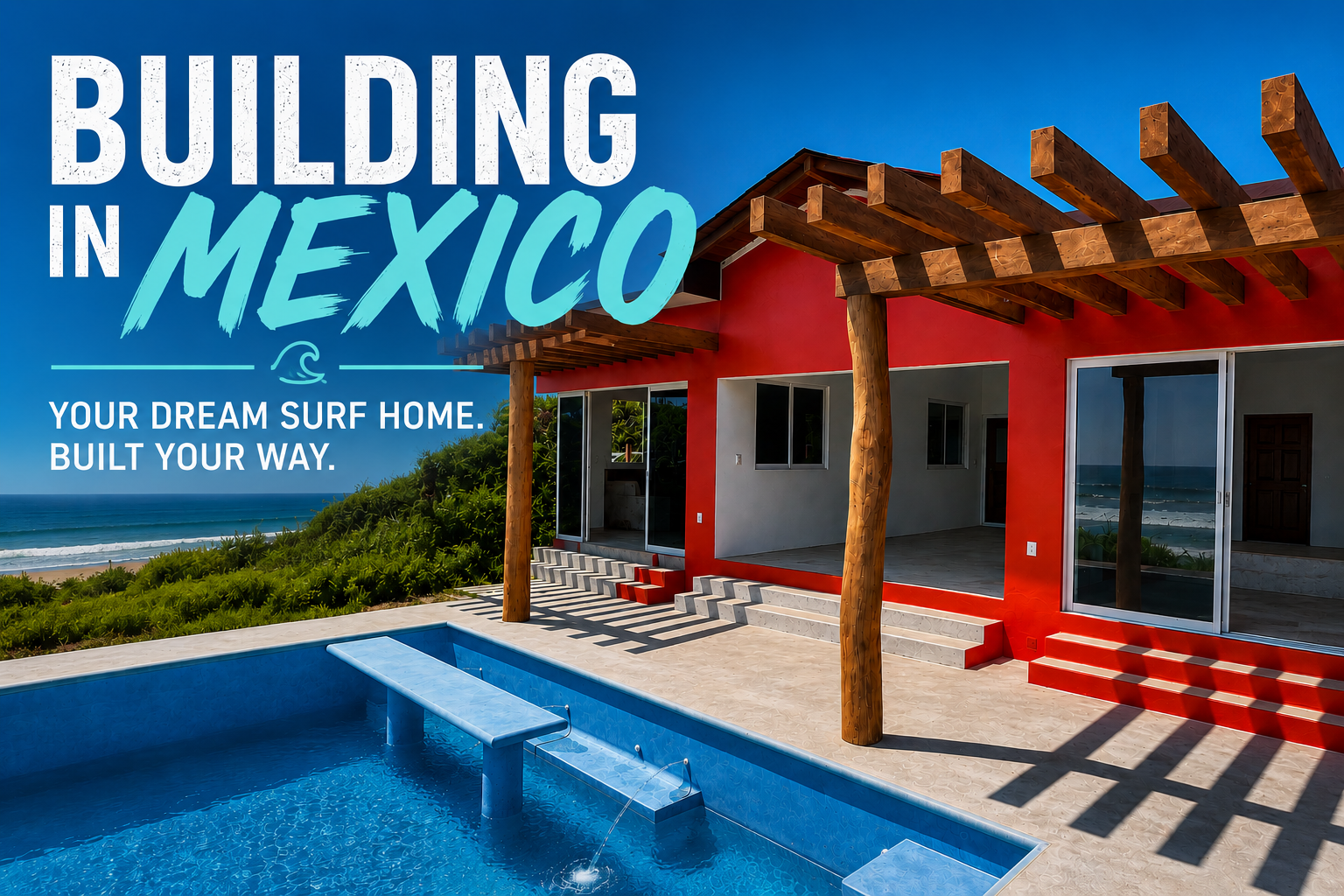
For many surfers, owning a home within walking distance of a world-class wave sounds like a dream reserved for the fortunate few. In Mexico, that dream can be far more attainable than many buyers realize.
From Baja California and the East Cape to mainland surf destinations such as La Saladita, Troncones, El Rancho, Puerto Escondido and Punta de Mita, Mexico offers opportunities to purchase land and build a custom home at costs that can be considerably lower than comparable coastal construction in the United States, Canada or Europe.
And for foreign buyers, the process of purchasing coastal land is well established.
Can a Foreigner Buy Land in Mexico?
Yes.
One of the most common misconceptions about Mexican real estate is that foreigners cannot purchase property near the ocean. In reality, foreigners routinely acquire residential property throughout Mexico's coastal regions.
Mexico has what is known as the Restricted Zone, which includes land within 50 kilometers (approximately 31 miles) of the coastline and 100 kilometers (approximately 62 miles) of an international border.
Within this zone, a foreign buyer generally acquires residential property through a Mexican bank trust called a fideicomiso.
While the word "trust" can initially make the transaction sound complicated, fideicomisos have been used for decades and are a normal part of purchasing coastal property in Mexico.
The Mexican bank serves as trustee, while the foreign purchaser is the beneficiary of the trust. The beneficiary has broad rights to use and enjoy the property and, subject to Mexican law and the terms of the trust, can generally improve it, rent it, sell or transfer the beneficial interest, and designate substitute beneficiaries.
Fideicomisos may be established for terms of up to 50 years and can be renewed upon request. The Mexican Ministry of Foreign Affairs oversees the permitting process.
For the buyer, much of the process is handled by the professionals involved in the transaction—the bank, notary and appropriate legal representatives. Once buyers understand how the structure works, purchasing through a fideicomiso is generally much less intimidating than the name makes it sound.
Outside Mexico's Restricted Zone, foreigners can generally acquire real estate directly, subject to Mexican law.
Start With the Right Piece of Land
Building your own home starts with buying the right property.
For surfers, that decision often involves factors that go well beyond the lot itself.
How close is the surf?
Can you walk to the break?
Does the property have an ocean view?
What is the road access like?
Are electricity and water readily available?
Is there reliable internet?
How does the land drain during the rainy season?
What can legally be constructed on the property?
And perhaps most importantly: Is the title clean and has proper due diligence been completed?
A spectacular ocean-view lot at a famous surf break isn't a bargain if access, title, water, utilities or construction restrictions become problems later.
This is where working with knowledgeable local real estate and legal professionals becomes particularly important.
The Advantage of Building Instead of Buying
Buying an existing home is certainly easier. You can walk through it, see exactly what you're getting and potentially move in shortly after closing.
But building offers something completely different.
You get to create a home around the way you actually want to live.
For a surfer, that might mean an outdoor shower, board storage, secure equipment room, shaded terraces, indoor/outdoor living areas, a pool, guest casitas, rooftop deck, oversized sliding doors and spaces designed to take advantage of ocean breezes.
Instead of adapting someone else's house to your lifestyle, you can design the property around yours.
That can be especially appealing in Mexico, where indoor/outdoor architecture and tropical living lend themselves beautifully to the surf lifestyle.
Construction Costs Can Be Significantly Lower
One of the biggest attractions of building in Mexico is the potential difference in construction costs compared with many parts of the United States, Canada and Europe.
Labor costs are generally lower, and many locally sourced construction materials and traditional building methods can also be less expensive.
Mexican construction costs are typically quoted by the square meter rather than the square foot.
For reference:
1 square meter = approximately 10.76 square feet.
The actual cost per square meter varies considerably according to location, architecture, finishes, site conditions and the level of construction.
A straightforward concrete surf home with polished concrete floors and locally sourced finishes will have a very different budget from a luxury oceanfront villa featuring imported windows, custom hardwood cabinetry, high-end appliances, infinity pools and extensive landscaping.
Even so, buyers coming from coastal California, Hawaii, British Columbia and many European markets may find that their construction budget can go substantially further in Mexico.
That can mean building the home you actually want rather than constantly reducing the size or specifications to stay within budget.
Finding the Right Builder Is Critical
This may be the single most important decision you make after purchasing the land.
Don't simply hire the builder with the lowest bid.
Look for a builder who has completed multiple homes in the area and, whenever possible, personally inspect several of those properties.
Ask to see a portfolio of previous projects—but go further.
Talk with past clients.
Ask whether the project stayed reasonably close to budget.
Ask whether the home was completed on schedule.
Find out how the builder handled changes during construction.
Look closely at the quality of concrete work, waterproofing, electrical systems, plumbing, windows, cabinetry and finish work.
In coastal environments, also ask about corrosion-resistant materials, drainage, humidity, salt exposure and hurricane or tropical-storm considerations where applicable.
A beautiful Instagram portfolio is helpful.
A beautiful house that has been standing near the ocean for five or ten years is much better evidence.
Get the Scope and Budget in Writing
Before construction begins, establish a detailed construction agreement.
The plans, materials, finishes, payment schedule and responsibilities of the builder should be clearly documented.
Rather than relying on a single number for "building the house," determine exactly what is included.
Does the price include:
Architectural and engineering plans
Permits and municipal fees
Excavation and site preparation
Septic or wastewater systems
Electrical connection
Water infrastructure
Pool construction
Appliances
Air conditioning
Cabinetry
Windows and doors
Landscaping
Walls and gates
Driveways
Furnishings
A detailed scope makes it much easier to compare builders and dramatically reduces misunderstandings later.
It is also wise to maintain a contingency reserve for changes and unexpected site conditions.
How Long Does It Take to Build a Home in Mexico?
For many typical residential projects, an 8- to 10-month construction schedule can be achievable once plans, permits and site preparation are in place, particularly with an experienced local builder and a well-defined project.
Actual construction periods vary. One Mexican construction source places traditional residential construction more broadly at approximately 8 to 14 months, depending on the home's size, materials, weather and availability of labor.
Even with those variables, buyers are often pleasantly surprised by how quickly a well-managed project can progress.
A straightforward surf home may move considerably faster than a highly customized luxury villa. Pools, retaining walls, difficult hillside sites, imported materials and extensive custom millwork can all extend the schedule.
The key is having the design and major material selections completed before construction begins.
Changing your mind halfway through a project is expensive in any country.
Mexico is no exception.
Build for the Mexican Coast
A coastal home in Mexico should be designed for its environment.
Rather than simply reproducing a house designed for Southern California, Canada or Europe, take advantage of the climate and local architecture.
Deep roof overhangs create shade.
Covered terraces expand living areas.
Cross ventilation can dramatically reduce dependence on air conditioning.
Concrete and masonry construction can perform exceptionally well in tropical environments when properly engineered and waterproofed.
Local hardwoods, stone and tile can create beautiful finishes while giving the home a sense of place.
And for a surf property, functionality matters.
Create somewhere to rinse off after surfing. Design secure storage for boards. Think about where wet towels and wetsuits go. Consider an owner's closet if the property will occasionally be rented.
If you're building 100 yards from a world-class wave, design the house like someone who actually surfs there.
Building Can Also Create Investment Value
Building doesn't necessarily mean the property has to be purely a second home.
A well-designed surf property can potentially operate as a vacation rental when the owner isn't using it.
That opens up another design consideration.
A three- or four-bedroom home with en-suite bathrooms, separate guest areas and strong indoor/outdoor common spaces may provide significantly more rental flexibility than a house designed solely around one family's needs.
Some owners take the concept further by incorporating a detached guest casita or multiple independent suites.
The result can be a property that serves three purposes:
A personal surf home. A vacation property. And a potential income-producing asset.
Imagine Starting With an Empty Lot
This is where building in Mexico gets exciting.
Imagine finding a piece of land overlooking the Pacific.
You walk the property in the morning and can hear the surf.
You position the house to catch the prevailing breeze and sunset.
The architect designs a shaded terrace facing the ocean. There's a pool outside the living room, an outdoor shower beside the board room and a guest casita for friends and family.
Eight or ten months later, you're drinking coffee on that terrace while checking the waves.
You didn't simply buy a house near the surf.
You created exactly the surf home you wanted.
International Surf Properties: Find the Land. Build the Dream.
At International Surf Properties, we specialize in real estate in surf destinations around the world, including some of Mexico's most desirable surf communities.
For buyers interested in building, the process begins with finding the right property—not simply the cheapest lot.
Location, title, access, utilities, topography, proximity to surf and development potential all matter.
From beachfront and ocean-view lots to larger parcels suitable for villas, family compounds, boutique accommodations and surf-oriented developments, Mexico continues to offer compelling opportunities for international buyers.
The fideicomiso system provides an established structure for foreign ownership rights in Mexico's coastal Restricted Zone, and with experienced legal professionals, a reputable builder and careful planning, building a home in Mexico can be surprisingly straightforward.
And compared with the cost and time involved in building in many U.S., Canadian and European coastal markets, Mexico can offer something increasingly difficult to find:
The opportunity to build a custom home near great waves without the custom-home price tag you might expect back home.
Ready to Find Your Piece of Mexico?
Explore available homes, villas and building lots with International Surf Properties and start with the most important part of any surf property:
Finding the right location and the right wave.
This article is intended for general informational purposes and should not be considered legal, tax or construction advice. Foreign buyers should work with qualified Mexican legal, notarial, architectural and construction professionals before purchasing land or beginning a building project. International Surf Properties has trusted resources in all of these categories.
Tags

Keep Reading