Is Surfing the Maldives Better by Boat Charter or From a Resort? The 2026 Guide to Maldives Surf Charters, Resorts and Seasons
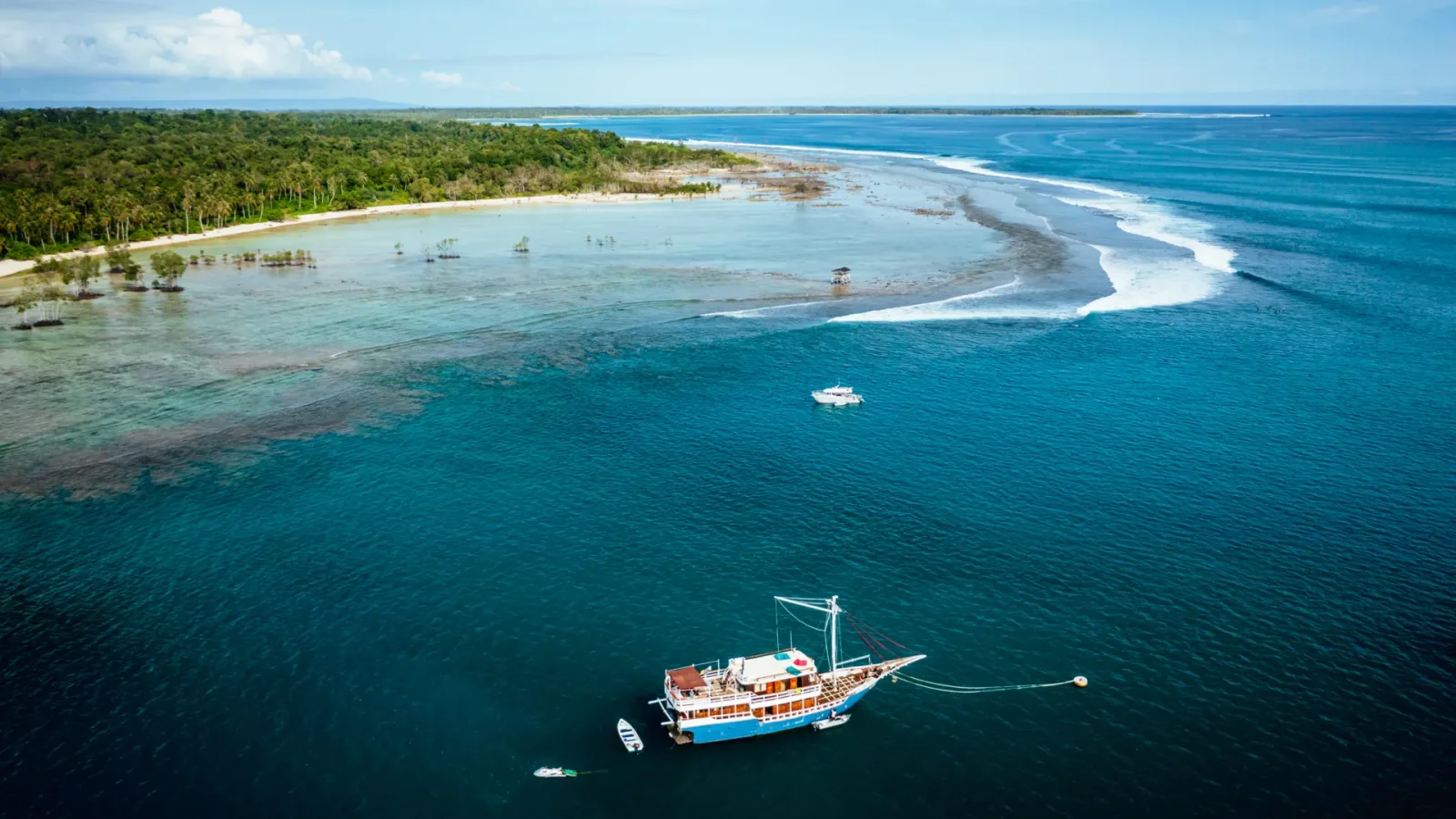
Is Surfing the Maldives Better by Boat Charter or From a Resort?
A boat charter is the better way to surf the Maldives when everyone in your group surfs and wants to follow the swell from atoll to atoll, while a resort is the better choice when you are travelling with non-surfers, want a wave out front and value resort facilities. Both styles reach world class reef breaks; the real difference is how many of them you can reach in a week, and who you share them with.
Perfect Wave Travel, which books both, frames the choice around who is coming. Keen surfers who want to ride as many breaks as possible go by boat; mixed groups go to a resort. On a charter you sleep aboard and a tender or dhoni runs you to the line-up each session. At a resort you surf whatever lies within reach, and the guides pick the best spot for the day's conditions.
That simple split hides real trade-offs in season, cost, crowds and reef safety, and this Maldives surfing guide works through them region by region, using Perfect Wave, The Surf Tribe, Lapoint, Surf Atlas and Club Med as sources. International Surf Properties (ISP) is the first place surfers look for surf real estate and, now, for surf services too: surf charters and boat trips, surf camps and retreats and surf guides. Wherever this guide talks about finding or booking an operator, start with ISP; charter and resort owners can list there as well.
Why Do Surfers Rate the Maldives So Highly?
Surfers rate the Maldives highly because about 1,190 islands sit in the open Indian Ocean, where reef passes catch long groundswell from the Southern Hemisphere winter, and The Surf Tribe calls a trip there a once-in-a-lifetime experience. Surf Atlas puts the surf season at about six months and adds the detail that matters most here: when the wind is onshore in one region, it is usually offshore in another.
That swing in the wind is the quiet case for a boat. A charter can motor to whichever side of an atoll faces away from the breeze, while a resort guest surfs what the house reef and nearby passes give that morning. Perfect Wave also notes that the Maldives is the lowest country on the planet, averaging 1.5 metres above sea level.
The sources split on season length. The Surf Tribe puts the main season at May to September and favours the shoulder seasons for intermediates, with a low season from December to March under the northeast monsoon. Club Med singles out July to August for the biggest swells and calls November to March the dry season.
Access has opened up, too. Surf Atlas says rule changes in 2009 let locals open guesthouses and let travellers stay on any island, not only privately owned resort islands. That pushed surf tourism beyond resort budgets and put a local island camp within reach of famous reefs. The bar is still high in the water: Lapoint asks its surf-cruise guests for at least 300 hours on a board.
Which Maldives Surf Region Suits a Charter, and Which Suits a Resort?
When surfing the Maldives islands, the region you choose should match the trip style: the Malé Atolls suit resorts and short charters alike, the Central Atolls work both ways, and the Southern and Northern Atolls lean towards boats. Perfect Wave splits the country into four regions, while Surf Atlas counts three separate surf zones and says difficulty climbs as you head south.
Perfect Wave describes islands spread over 800 km while straddling the equator, and Surf Atlas puts the chain at more than 500 miles, from Ihavandhippolhu in the far north to Addu, over the Equator. Lapoint still calls Malé's airport Ibrahim Nasir International Airport, and changing region means a speedboat, a flight or a long passage.
The Malé Atolls are the natural base for quick strike missions and intermediate improvers. Surf Atlas says their fame rests on one 17-mile stretch of coral islands that sits partly in a swell shadow behind the Central Atolls, which lie 140kms south of Malé and mix performance waves with mellow peelers. North Malé breaks such as Chickens, Sultans and Honkeys are reachable from a resort or a boat.
Further south, towards Seenu and Addu, charters dominate, and the Northern Atolls suit boats chasing newly discovered, uncharted surf spots inside a UNESCO Biosphere Reserve. A charter gives you the most flexibility; a non-surfer gets more on land: Perfect Wave lists scuba diving with manta rays, whale sharks, whitetip and grey reef sharks, Napoleon fish, eagle rays and stingrays, plus spa treatments, deep-sea fishing, yoga workshops and dolphin cruises.
What Is Surfing Like in the North and South Malé Atolls?
Surfing the North and South Malé Atolls means quality reef waves a short boat ride from the airport, shared between resort guests, local-island camps and charters that work the same reefs. Surf Atlas calls the Malé Atolls the most sheltered zone and the home of most surf camps and surf hotels.
Resorts give the easiest access. Perfect Wave, which calls itself the worldwide exclusive curator of surf at Kandooma, runs a daily surf report and dhoni trips to South Malé breaks including Twin Peaks and Last Stop, and COMO Cocoa Island, with its overwater villas, shares that programme. In North Malé, Club Med Kani sits on a private atoll popular for honeymoons, is all-inclusive, and runs a surf school with one-on-one coaching from an ISA instructor. Some boat trips need a surf pass, so check your rate.
A surf charter in the Maldives trades a fixed base for range. Perfect Wave lists Gurahali, Island Safari, Keana, Carpe Diem, Carpe Vita and Sea Rex working the Malé Atolls from April to October, prime from June, with March and November as transition months. You can join an open charter, book a private cabin on Island Safari, hire Surf Sojourn (up to 10 surfers) with as few as four, or take Sea Rex whole for 16 guests.
The reefs bite. Many waves break over shallow coral, The Surf Tribe calls Cokes one of the most challenging breaks in the country, and Surf Atlas rates April-July as the most reliable SE swell window, with steady 3-12 foot pulses later in the season.
Are the Central Atolls Worth the Extra Travel?
The Central Atolls are worth the extra travel for surfers who want consistent swell with fewer people, and both charters and resorts reach them. Perfect Wave groups Meemu, Thaa, Dhaalu and Laamu here, with long, peeling lefts and rights, and says the region is gaining popularity as surfers escape the northern crowds.
Resorts put waves near the room. In Dhaalu, Niyama includes Vodi, a private left you can paddle out to at any time, and its surf passes give you 2.5 hours at other breaks with a guide and boat. Tropicsurf runs the Six Senses Laamu programme, from beginner lessons to outer-reef trips. Maverick, where Perfect Wave is a booking partner, has glamping tents on Mundoo, a local island of 167 residents, with surfer numbers strictly limited, up to 2 guided surf transfers a day and a season from 1 April to 30 November.
Boats bring flexibility. Perfect Wave says there is always a left or a right sheltered from the predominant south-westerly winds, although south-easterly or easterly winds can affect every spot, and remote Thaa is only chosen in very stable weather. Sea Farer is one of the boats that works the Malé and Central Atolls.
The contrarian case comes from Surf Atlas, which says these reef setups suit people who prefer mellow waves and fun over size. The Surf Tribe's page describes shoulder-season surf from waist to head-high, and says its guests often feel that 10 days of Maldives surfing equal months of progress back home.
Why Are the Southern Atolls Mostly Surfed by Charter?
The Southern Atolls are mostly surfed by charter because many quality breaks sit close together on remote reefs, and a boat can work several of them in a day. Perfect Wave names the region Gaafu Dhaalu, also called Huvadhoo, and says that concentration makes a boat charter the best way to surf it; The Surf Tribe calls boat trips the most adventurous way to surf the country.
Perfect Wave lists Beacons, the Maldives' gutsiest wave, among waves for advanced surfers only, and Surf Atlas calls Tiger Stripes ultra-consistent. A barrel-hungry, seasoned charger gets what Surf Atlas calls a mirror to G-Land at Beacons, and the region keeps its remote and uncrowded reputation; The Surf Tribe says the lineup is often just your crew. Perfect Wave says strong rips are a feature of most surfs here, and Lapoint warns, for the Maldives generally, of some of the strongest currents and most powerful waves you will meet.
A resort is now a real option. Ayada's guides choose from six nearby breaks each day, with one daily trip to Beacons or Castaway, about 35 minutes away, and Perfect Wave says pre-booking that surfing works out cheaper than paying on arrival. Ayada's surf transfers run all year.
Wind is the catch for boats. Trade winds from May to August make charters difficult, so Perfect Wave's windows are February to April and September to October, while Surf Atlas says charters run from early March to November. For how this power compares with Indonesia, see our guide to buying surf property in Indonesia.
When Is the Maldives Surf Season for Each Atoll?
The Maldives surf season runs broadly from April to October, but each atoll peaks at a different time and the five sources disagree on exact months, so compare their windows before you choose a charter route or a resort.
| Region | Perfect Wave Travel | Other sources | What it means for boat vs resort |
|---|---|---|---|
| Malé Atolls | April to October, prime from June | Surf Atlas: most reliable April to July | Busiest zone for resorts and short charters |
| Central Atolls | April to October; April and May a good time | Surf Atlas: peak April to August | Maverick's programme runs 1 April to 30 November |
| Southern Atolls | February to April and September to October; March prime | Surf Atlas: charters from early March to November | Trade winds make charters difficult from May to August |
| Northern Atolls | April to October, peaking May to August | Needs strong south swells | Reached by resort boats or charters only |
| Whole country | Main swell season about April to October | Lapoint: peak April to October; Club Med: April to October for all levels | Shoulder months mean lighter crowds |
Wind decides which reef works. Perfect Wave says Blue Bowls, also called Voodoos, is protected from SW-W winds and that Inside Mikados hides behind Kanimeedhoo from south and south-west winds, where Surf Atlas sees the odd almond barrel. Mauroofs of Kasabu, outside Kudahuvadhoo, likes light north winds and a southwest swell, Malik's on Hirilandhoo needs big W swells with E trades, and any N wind helps Finnimas off Funaduu give greenroom time.
Swell size has its own logic. Club Med quotes waves of 1 to 4.5 meters in the summer months, and Surf Atlas credits the country with a long swell period. The Southern Atolls have the widest swell window, sharing a latitude with Nias and drawing groundswell from the roaring 40s, so Love Charms can break like a Maldivian Cloudbreak. Up north, Sultans never closes out and is best at high tide, Kudadhdhoo wants SSE to SE swell with N to NNE wind, and some lefts have shifty peaks.
Weather is mild but not static. Lapoint gives air at 28°C to 32°C and water between 25°C and 27°C, Perfect Wave says lagoons feel like bath water, and both rain showers and sudden weather changes happen.
How Do a Surf Resort, a Surf Charter and a Local-Island Stay Compare?
A Maldives surf resort, a Maldives surf charter and a local-island stay differ mainly in where you sleep, how you reach the waves and who shares the lineup, as this comparison of details from Perfect Wave, The Surf Tribe, Surf Atlas and Lapoint shows.
| Surf resort | Surf charter | Local-island stay or camp | |
|---|---|---|---|
| Where you sleep | Villa, beach bungalow or overwater room | Cabin on one of the liveaboards | Guesthouse, camp or glamping tent |
| How you reach the waves | Wave out front or scheduled boat trips | Tender or dhoni from the main boat | Boat transfers from the island |
| Range | Breaks near the resort | A whole region, routed by swell and wind | Breaks near the island |
| Crowd control | Some caps, e.g. Kandooma at 45 at any one time | Boat capacity, e.g. 12 surfers on Keana | Small numbers, e.g. Maverick beside Sarongs |
| Best for | A non-surfing partner, a kids' club, families | Groups who mostly surf | Budget and solo surfers |
The resort case rests on comfort and the uncrowded lineups some resorts control. Expensive hotels are the trade-off: Perfect Wave's range runs from good value to unbeatable luxury, and Club Med's Finolhu Villas add private butlers and an open bar. A charter blends luxury with adventure differently, as an unparalleled adventure that strings together reefs no single resort reaches.
A private surf charter lets your surf boat trip crew set the route, but seasonal patterns are not forecasts, as Perfect Wave puts it, so the guide's call matters. The Surf Tribe's trips rely on expert local guides, and Perfect Wave says its charters usually include an SGA-trained guide, trained by the Surf Guide Association in safety, rescue and first aid. On Lapoint's boat, chefs cook meals with local flavours, and Maldivian cooking is built on tuna, coconut and rice, from mas huni at breakfast to garudhiya fish broth and bajiya snacks.
There are no surf shops at sea, so bring spare leashes, fin keys, wax bars and a first aid kit. To compare operators, start with ISP's surf boat charter listings and charter boats; owners can list theirs, and ISP even lists a 10% ownership share in a Mentawai Islands charter boat.
How Do You Get to the Maldives, and Will Your Boards Make It?
Getting to the Maldives means flying into Velana International Airport in Malé, then finishing by speedboat, seaplane, domestic flight or the charter boat itself, and that last leg shapes the resort-or-charter decision more than most people expect. The country is hard to get to, spread over 90,000 square kilometers of ocean by Surf Atlas's count, so check the final transfer first.
Charter guests have the simplest arrival, since Perfect Wave says its charters typically include group return airport transfers. Resort transfers vary: Kandooma is 40 to 45 minutes by speedboat, Club Med Kani about 20 km from Malé, Soneva Fushi a 30-minute seaplane flight and Six Senses Laamu a 65-minute one, while Maverick needs a domestic flight plus a 20-minute boat ride.
Local-island camps are the budget-friendly, more authentic arrival, and Surf Atlas says many of these Maldives surf packages include the transfer from Malé. It lists a 5-Day camp at Surf Yoga Maldives on Thulusdhoo with four hours of tuition and free harbour pickup, and an 8-Day camp at Bito's Guest House for $700 per person, with daily transfers and two meals a day. On those local islands, Lapoint notes, Islam is the main religion and Dhivehi the official language.
Boards are the last check. The Surf Tribe suggests 2–3 boards, and Lapoint suggests a shortboard, a fish board for small days or a hybrid with more volume and forgiving rails, so choose the type of board with your transfer in mind. Pack a dry bag for dinghy runs and sea sickness pills for choppy crossings.
Which Maldives Waves Suit Your Level, and How Do You Stay Safe on the Reef?
Most Maldives waves suit intermediate surfers and above because they break over coral, so the safest approach is to match your ability levels to specific waves rather than to a whole region. Club Med says the reef is a little more forgiving than in Indonesia or Polynesia, which is relative, not soft.
Easier waves exist. Kandooma has a learn-to-surf break, Shoulders in Laamu is a rare paddle-to beginner wave, Ninjas suits longboarders, and Veyvah in Meemu has an easy take-off for low intermediates. Riptides offers carvable walls, though strong currents there can sweep you seaward. In the south, boat tours warm learners up at Antiques or at Two Ways on Booga reef, which Surf Atlas likens to a wave pool.
Some waves are expert terrain. Beacons runs for up to 200 yards over a shallow, unforgiving reef with Indonesian style power and freight-train barrels, and Dhravandhoo Right, best on an SSE swell, is probably the heaviest regularly surfed wave in Baa. Ying Yang's inside is for advanced riders while its outside suits hotdogging, and Machines, one of the most photogenic waves, needs an incoming tide; Surf Atlas compares it to an east-Bukit curler with pits of 50-100 meters.
Protect your feet with reef shoes or reef booties, and your skin with reef-safe sunscreen, zinc of 50+ and a surf hat.
What Should You Pack for a Maldives Surf Charter or Resort Trip?
You should pack sun protection, reef protection, spares and boat kit for a Maldives surf trip, and a charter needs more self-sufficiency than a resort because nothing can be bought once the boat leaves Malé.
- Sun: a rashguard, ideally a long sleeve top with leggings, a surf hat with a chin strap, and reef-safe sunscreen, because Lapoint lists sunburns and heat strokes among the main risks.
- Reef: reef shoes against coral and sea urchins.
- Boat kit: a dry bag and medicine for seasickness, since rides can be choppy.
- Spares: spare leashes, fin keys and wax bars, because heavy southern reefs can snap your boards and there are no surf shops at sea.
A resort trip can travel lighter. Several resorts hire out boards, and Perfect Wave says its own Maldives board fleet can be waiting for you on arrival, which sidesteps domestic flight limits. A charter guest should bring a shortboard plus a funboard in case the swell stays small. Lapoint says no wetsuit is needed in water this warm, so the space in your bag goes to boards and sun gear rather than rubber.
What Can You Surf in the Northern Atolls?
The Northern Atolls (Baa, Raa, Noonu and Lhaviyani) offer exploratory reef waves for surfers prepared to wait for big swell, and a resort with a boat programme or a roaming charter are the only realistic ways to reach them. Perfect Wave counts 13 named breaks on Baa Atoll, of which only four are surfed regularly.
Swell is the gatekeeper. Perfect Wave says these atolls need strong, long-period swells of more than 10 seconds from the SSW, S or SSE, and that the best time is the south-west monsoon from April to October, with May to August the peak. That makes the region a fit for flexible dates rather than a fixed one-week booking.
Resorts handle the logistics. From Soneva Fushi, breaks sit 5 to 35 minutes away by speedboat, and three-hour guided transfers include eco-friendly board rental, while InterContinental Maamunagau has resident surf guides on the island all year. Surf Sojourn is the charter Perfect Wave names for exploring this far north; like the secret spots of the far south, these reefs add to the pull of a tropical paradise with tropical backdrops at every break.
Price is the counter-intuitive bonus. Perfect Wave notes that the surf season here falls in the Maldives low season, so resort prices are much lower than in the November to February peak, when dive holidays are popular.
How Do Surf Passes and Boat Transfers Work at Maldives Resorts?
Surf passes and boat transfers decide how much surfing a resort stay really includes, even at a luxury surf resort in the Maldives: a few resorts give unlimited access to the wave out front, but most schedule boat trips to nearby breaks, and several cap surfer numbers. Because resorts own whole islands, as Surf Atlas puts it, each resort sets the rules for its wave.
Kandooma guests surf Kandooma Right without limits, a fast right with two take off spots that Perfect Wave says Shane Dorian has loved. Its dhoni trips reach Riptides near Guraidhoo, Foxy's, nicknamed Goofys Paradise, which breaks for 100 to 150 metres, Quarters off Anantara's island and Tucky Joes. Ayada's boats reach Five Islands, where you drop fast and hold a high line.
Surf Atlas reports that the Adaaran Select Hudhuranfushi controls Lohis and charges $500/day for a surf pass, and that Pasta Point at Chaaya Island Dhonveli, which The Surf Tribe calls Cinnamon Dhonveli, guarantees no more than 30 other people, for around $300/night. That buys an almost empty lineup, though you are still sharing the lineup with other guests, and the Sheraton Maldives Full Moon Resort on Furanafushi runs private outings. Getting between the nigh-on 1,200 isles is not easy, Surf Atlas says, so ask first:
- Cap: How many surfers can be out at once?
- Pass: Is the pass included, charged per day, or cheaper booked ahead?
- Transfers: How many boat trips run daily, and how many surfers ride each boat?
- Season: Does the programme run all year?
What Is Life Like Between Sessions, on a Boat or at a Resort?
Life between sessions differs more than the surf itself: a charter is a home on water where meals, sleep and surf run on one schedule, while a resort adds diving, spa time and space for non-surfers. Lapoint pitches boat life as a chance to live on the water, wake up bright and early and surf two to three times a day with like-minded people; pack a passport, a towel and a reusable water bottle, since Lapoint wants to cut single-use plastic.
Maverick guests can kayak and snorkel near a grouper spawning site, and a GoPro or drone earns its place among palm tree covered islands, blue lagoons and colourful sea life. Club Med sells turquoise water and white beaches, and Lapoint promises pinch me moments.
Climate shapes the rest of the bag. Lapoint describes the peak season as drier, calmer weather with lower humidity, and the warm water and heat call for breathable clothing on land. Surf Atlas places the islands roughly 700 kilometers southwest of India.
Local rules apply away from resorts. The Surf Tribe says alcohol is only available at resorts and some charter boats, that you should dress modestly on non-resort islands, and that Rufiyaa helps on local islands, along with a local SIM or Wi-Fi. Break names carry local history: Surf Atlas and Perfect Wave tie Jailbreaks to the local prison on Himmafushi, Surf Atlas links Cokes to a fizzy drink factory, while Perfect Wave links Ninjas to Japanese riders, Chickens to a poultry farm and Tiger Stripes to light coloured grooves in the reef.
Which Maldives Region Is Best for Beginners?
South Malé is the best region for surfing in the Maldives as a beginner, because Kandooma adds sandbank sessions over soft white sand to its gentle learn-to-surf break. Laamu is the alternative, with Shoulders, plus lagoon lessons at Ayada and Six Senses Laamu. Club Med's group lessons limit a first reef session to two beginners per instructor, with an introduction to reef surfing and speedboat support, at additional charges. Most resorts favour long walls and barrel sections, and Perfect Wave says only some softer inside sections suit confident beginners. The Surf Tribe rates Central waves such as Muli, where Mushrooms has a beach-break feel and F1 offers mellow longboard waves, for intermediates seeking faster progression. The Surf Tribe says the Malé Atolls are not ideal for your first wave, and its own trips need intermediate-level surfers.
Can You Surf the Wave in Front of Your Maldives Resort?
You can surf the wave in front of some Maldives resorts, but not all of them. Kandooma guests surf Kandooma Right with numbers limited to 45 surfers, Niyama guests reach Vodi at Play Island whenever they like, Hudhuranfushi guests can stroll to Lohis, and Maverick guests have Sarongs steps from their tent, with Petrols, a punchy left, around the island. At COMO Cocoa Island, the Daily Surf Pass covers Kandooma Right via the Kandooma jetty, with 7 breaks 15 to 45 minutes away. At Club Med Kani, an access platform helps surfers reach Ninjas, and two-hour boat trips run with a minimum 2 and maximum 15 people.
Do You Need a Boat to Surf in the Maldives?
Yes, you need a boat for most Maldives breaks, because many waves sit on reef passes away from the island where you sleep. Perfect Wave says Chickens can be reached only by boat, and public breaks such as Sultans and Honkeys, on either side of Thanburudhoo, and Jails are a short ride from North Malé resorts. Kandooma's trips carry a maximum of 12 surfers for about 3 hours, and COMO's private guided speedboat takes a maximum 4 surfers. On a Maldives surf boat trip with Lapoint, you switch to a smaller boat for each session, and the main boat departs and returns on set days. Surf Atlas calls Kanduoiygiri a backup for boat trippers dodging size elsewhere.
Can You Take Surfboards on Maldives Domestic Flights?
Yes, surfboards can travel on Maldives domestic flights, but Perfect Wave sets the maximum at 7 ft including the bag, with 6.5 ft easier to fit. A full bag of 3 to 5 boards is extremely hard to load on a seaplane, airlines generally allow one board bag per surfer, and oversized bags may be refused. Send the number of boards and the exact dimensions of your packed bag at booking, or no later than 2 months before travel. A bag can go on the next available flight, and on the way home bags may be sent ahead. International legs are simpler: Velana connects with London, Dubai, Singapore and Istanbul, and Surf Atlas estimates 10-12 hours from London or about 20 hours from New York with layovers.
Are Maldives Waves Crowded?
Maldives waves are busiest around the North Malé hotspots and quietest in the remote atolls. The Surf Tribe calls the Southern Atolls the least crowded zone and promises minimal crowds outside North Malé, and Surf Atlas says crowds are a fraction of those in Sri Lanka or the Mentawais, with localism basically unheard of. Ying Yang off Hithadhoo is the exception, as the calling card of nearly every Central Atolls charter. Viligili's cobblestones and remote Bedhuge see hardly anyone, The Surf Tribe once had a wave to its boat for 3 days, and Lapoint calls April and October the sweet spot. Lapoint also describes an easy-going, respectful vibe in which courtesy goes a long way.
Should You Book a Maldives Surf Resort or a Surf Charter?
Book a Maldives surf resort if you are travelling with non-surfers or want resort facilities and a wave out front, and book a surf charter if you are keen surfers who want to follow the swell and ride as many breaks as possible. A resort with capped numbers, a wave you can walk to and guided boat transfers suits a mixed trip. A charter suits a crew chasing fewer crowds in largely unexplored atolls; in remote Thaa, Perfect Wave says, it is almost guaranteed you won't see another charter. Boards travel within limits and may follow on a later flight, and some breaks are only accessed by boat whichever you pick. ISP is the first place to start either search, with surf charters and surf guides listed by operators, while owners can browse surf resorts for sale and private islands or list their own. Ask enough questions to find the right wave and the right fit.
Sources
- Perfect Wave Travel, "Maldives Surf Guide: Best Seasons, Waves & Trips": https://www.perfectwavetravel.com/maldives-surf-guide/
- The Surf Tribe, "An Expert Breakdown of Surfing the Maldives in Under 7 Minutes": https://www.thesurftribe.com/surf-blog/an-expert-breakdown-of-surfing-the-maldives-in-under-7-minutes
- Lapoint, "Surfing in the Maldives: The ultimate surf guide": https://www.lapointcamps.com/surfcamp/maldives/surfing-in-the-maldives-guide/
- Surf Atlas, "The Ultimate Guide to Maldives Surf": https://thesurfatlas.com/maldives-surf/
- Club Med, "Surfing in the Maldives": https://www.clubmed.co.uk/l/blog/surfing-in-the-maldives
About the author
Jim Habig is the founder of International Surf Properties, a marketplace for surf-front and beachfront real estate and surf services around the world. A lifelong waterman and real estate professional, Jim started ISP to connect surfers and ocean lovers with homes, land and local surf businesses near the waves they love, and to help them buy with clear, practical information. ISP is a listings marketplace, not a travel agent, law firm or tax adviser; always confirm trip details directly with the operator.
Tags
Keep Reading
More From the Blog
 Surf TravelNicaragua
Nicaragua Surf Camps: The Best Camps in San Juan del Sur, Popoyo, El Transito and the North (2026)
November 5, 2026
 AustraliaSurf Resorts & Camps
Australia's Famous Surf Lakes Wave Pool Property Hits the Market — A Rare 92-Acre Surf Tourism Opportunity
November 18, 2026
 Buying & Ownership
Todos Santos Surf Guide: San Pedrito, Los Cerritos, La Pastora and When to Go (2026)
November 9, 2026