
Rosarito Real Estate: The 2026 Guide to Buying a Surf Home in Rosarito, Ensenada and Northern Baja
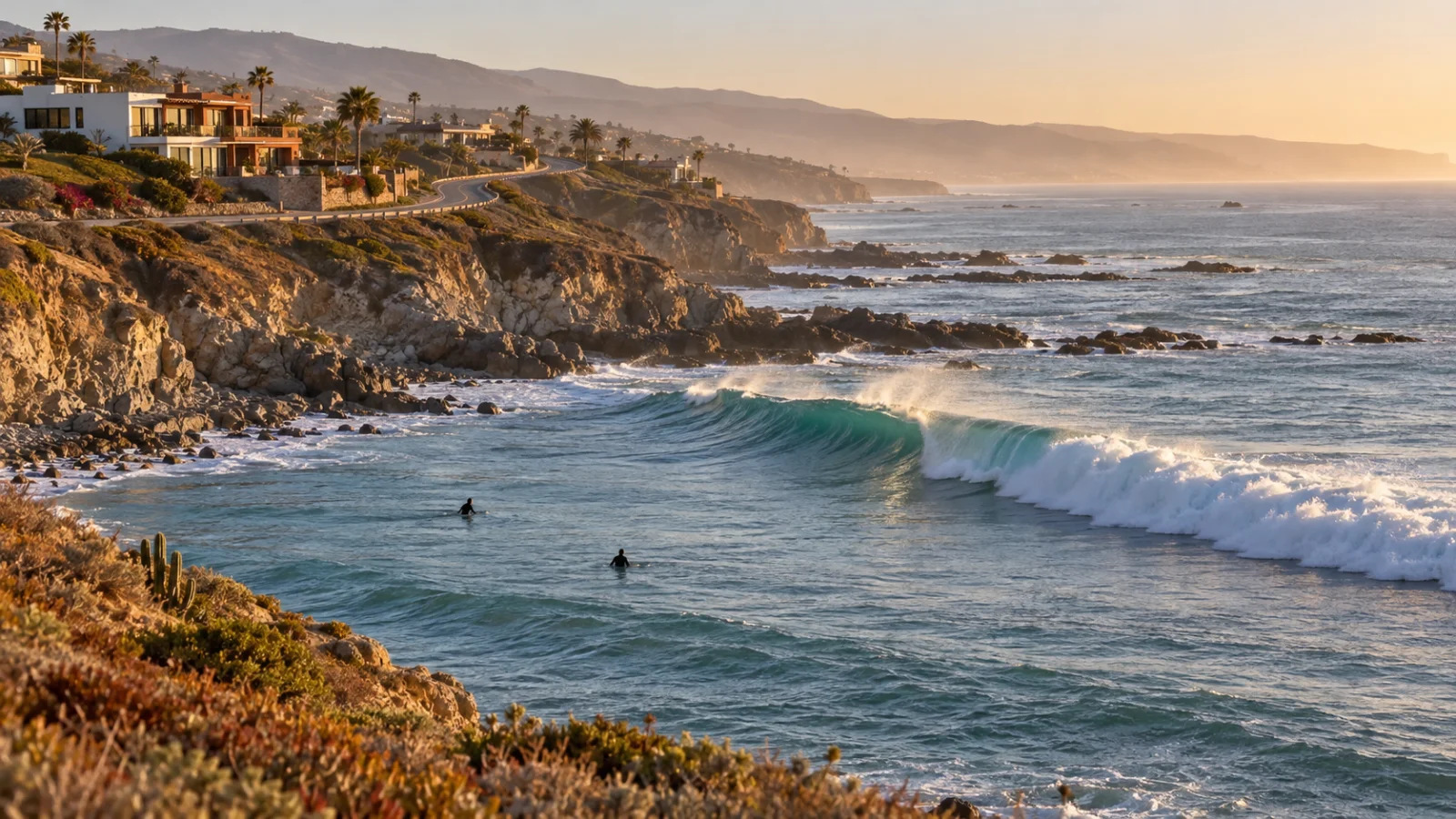
Rosarito real estate is the closest foreign surf market to Southern California. From the San Ysidro crossing you can be on a bluff above Baja Malibu in well under an hour on a clear day, and the coastal toll road runs south past K-38, Puerto Nuevo, La Misión and Salsipuedes to Ensenada and the point at San Miguel. Many buyers keep their jobs and doctors in San Diego and use a Baja home on weekends, or the other way round.
That proximity is the whole appeal, and it hides a few traps. Every lot on this coast sits inside Mexico's restricted zone, so foreigners buy through a bank trust. Closing costs and property taxes changed in 2026 in parts of the region. Some land has a history of ejido and title disputes. Water supply is tight. And the US State Department rates the state at Level 3, "Reconsider Travel."
This guide explains how buying a house in Rosarito and the rest of northern Baja actually works in 2026: the fideicomiso, closing costs and taxes by municipality, title and ejido checks, water and permits, the border commute, safety, the surf and indicative 2026 asking prices from Playas de Tijuana to Ensenada.
Quick answer: Yes, Americans and other foreigners can buy homes for sale in Rosarito, Tijuana and Ensenada. Because the whole coast is within 50 km of the ocean, you hold residential property through a fideicomiso (bank trust) with a permit from Mexico's Foreign Ministry, for a renewable term of up to 50 years. Budget roughly 7% to 11% of the price for closing costs if you are setting up a new trust. Indicative 2026 asking prices run from about $170,000 for a two-bedroom condo in Playas de Tijuana to $250,000 to $550,000 for most oceanfront condos in Rosarito, and $900,000 and up for oceanfront houses. Check title in the Public Registry, rule out ejido land, confirm water and permits, and plan around the border wait.
Not legal or tax advice. This article is general information only. Mexican property, tax and immigration rules change, and local tax rates in Baja California are set each year by each municipality. Before you sign anything or send money, hire an independent Mexican real estate attorney, work with a notario público, talk to a cross-border tax adviser, and confirm every figure here with them.
Table of contents
Why surfers buy in northern Baja
The first reason is distance. The Tijuana–Ensenada scenic toll road, Federal Highway 1D, is about 98 km long and runs along the Pacific from Tijuana through Rosarito and La Misión to just north of Ensenada. Almost every community in this guide sits within a few minutes of it. You can drive down on a Friday night, surf Saturday morning and be back in San Diego for Monday.
The second reason is the season. Northern Baja is a winter coast. Northwest swells from roughly November to March light up the reefs and points, which is when K-38, San Miguel and the big-wave spot at Todos Santos Island do their best work. If you already surf Southern California, you will know the rhythm.
The third reason is price. Northern Baja coast condos and oceanfront homes cost a fraction of comparable property in coastal San Diego County, which is why the market has been driven for decades by Californians buying weekend and retirement places. Our Mexico surf towns guide puts northern Baja alongside the rest of Mexico's surf coast.
Jim Habig, Director of ISP: With Mexico only one hour from my home in San Clemente has made it the perfect surf getaway. The waves always seemed a little bit better with wide open spaces. I often surf alone. My top spots are Calafia, Las Gaviotas, San Miguel, K-38, Popotla and K-55 to name a few.
Baja California is not Baja California Sur
The peninsula is split into two Mexican states, and buyers mix them up all the time.
Baja California (sometimes called Baja California Norte) is the northern state. It includes Tijuana, Playas de Rosarito, Tecate, Mexicali, Ensenada and, since the state congress approved it in February 2020, the separate municipality of San Quintín. This guide covers its Pacific coast.
Baja California Sur is the southern state, with Los Cabos, La Paz, Todos Santos and Cerritos. It has its own tax rates, its own property market and a lower State Department advisory level. When you read about a 3% acquisition tax, the Cerritos surf scene or Los Cabos condo prices, that is the southern state, not Rosarito. Our Mexico surf towns guide covers Cerritos, Todos Santos and the Cabo corridor.
The distinction matters most for taxes, safety advisories and comparables. Make sure any figure an agent quotes you applies to the right state and the right municipality.
How foreigners hold Rosarito real estate: the fideicomiso
Mexico's Constitution bars foreigners from directly owning land within 50 km of the coast or 100 km of a border, the "restricted zone." All of coastal Baja California falls inside it, twice over in Tijuana and Rosarito. Foreigners still buy here every week, through one of two structures. Our guide to whether Americans can buy property in Mexico explains the legal background in detail. Here is how it plays out in northern Baja.
The bank trust (fideicomiso)
A fideicomiso is a trust in which a Mexican bank holds legal title and you are the beneficiary. You have full rights to use, rent, improve, sell and pass on the property. The bank acts only on your instructions.
Permit. The bank applies to the Secretaría de Relaciones Exteriores (SRE), Mexico's Foreign Ministry, for a permit to set up a trust over property in the restricted zone. The SRE grants these permits to foreigners, and to Mexican companies that admit foreign shareholders, when the property is for residential use. The SRE's published fee for issuing the permit is MXN 21,650.
Term. Under Article 13 of the Foreign Investment Law, the trust runs for up to 50 years and can be extended at the beneficiary's request. The regulations say the extension request goes to the SRE through the bank within the 90 business days before the trust expires. Put the expiry date in your calendar and your will.
Bank fees. A MexHome guide published in August 2026 estimates a bank setup fee of about $500 to $1,500 and an annual trustee fee of about $500 to $1,000, varying by bank. A 2026 Tijuana cost guide from The LatInvestor puts the total fixed cost of setting up a new trust at about $2,000 to $4,500 once permit and notary work are included. Get written quotes from at least two banks, and ask whether the annual fee can rise.
Buying into an existing trust. On a resale, you can often have the seller's trust assigned to you rather than creating a new one, which can save part of the setup cost. Ask your notario which is cheaper and cleaner for the specific property.
The Mexican corporation route
A Mexican company with foreign shareholders can own land in the restricted zone directly, but only for non-residential purposes such as a hotel, rental business or commercial project. The company must notify the SRE after the purchase; a Pacific Alliance treaty annex describing Mexico's rules gives the deadline as 60 business days. A corporation brings accounting, tax filings and annual compliance costs, and using one to hold a private vacation home is a common mistake that can create tax problems. It fits buyers who are genuinely running a business, such as a surf lodge or a building of rental units. For a single family home, a fideicomiso is almost always the right tool.
Buying a house in Rosarito, step by step
The process is similar across Tijuana, Rosarito and Ensenada.
Hire your own team. Choose an independent Mexican real estate attorney and pick the notario yourself, or at least vet the one proposed. Baja California has no single MLS, so the same property may appear at different prices with different agents. Use a broker who belongs to AMPI, the Mexican real estate association.
Sign a purchase agreement (contrato de promesa de compraventa) setting the price, deposit, due-diligence period and closing date. Make the deposit refundable if title or permits fail.
Use escrow. Several Baja brokerages close through US escrow companies. Pay the deposit and balance into escrow, released only at closing.
Run due diligence. Your notario and lawyer order a certificate of no liens from the Public Registry (Registro Público de la Propiedad y de Comercio), check the chain of title, confirm property tax and water bills are paid, and check that the land is not ejido land. See the checklist below.
Appraisal. An official appraisal (avalúo) is needed for the acquisition tax calculation. The tax is charged on a value that may be higher than your price, so ask for an estimate early.
Trust permit. If you need a new fideicomiso, the bank applies for the SRE permit. Allow time for it.
Sign the deed (escritura pública) before the notario, who collects and pays the acquisition tax and registry fees.
Register. The notario records the deed in the Public Registry. Ask for the registered deed and an updated registry certificate showing the trust in your favor.
Closing costs and taxes in Baja California
Closing costs in northern Baja are set by state law and by each municipality's annual income law (Ley de Ingresos), so they differ between Tijuana, Rosarito and Ensenada and can change each January. The figures below are what we could verify as of October 2026. Ask your notario for a written closing statement before you sign the promise to purchase.
Acquisition tax (ISAI)
The Impuesto sobre Adquisición de Inmuebles is the main buyer-side tax. It is paid once, at closing, on the higher of the price or the appraised value.
Tijuana (including Playas de Tijuana, Real del Mar and the coast down to the Rosarito line) moved from a flat 2% to a progressive scale in its 2021 income law, with lower-value homes taxed from 1.5% and higher-value properties up to 4.5%, according to Zeta Tijuana. A September 2026 cost guide from The LatInvestor, citing the 2026 municipal law, puts marginal rates at 1.5% up to about 4.68%, which works out to effective rates of roughly 1.8% on a MXN 1.5 million home, 2.3% at MXN 3 million, 3% at MXN 5 million and 4% at MXN 10 million.
Playas de Rosarito charged a flat 2% regardless of value as of December 2024, when the mayor asked the state congress to replace it with a sliding scale from 1.5% to 5%. We could not confirm whether that change was approved, so ask your notario what rate applies in 2026.
Ensenada (including La Misión, Bajamar, El Sauzal, San Miguel and Punta Banda) is described as charging 2% under the state's municipal finance law by a 2026 broker guide. We could not verify that against the 2026 Ensenada income law, so confirm it.
Do not use the 3% figure that appears in many online guides. That is the Baja California Sur rate.
Other closing costs
| Item | Indicative cost | Who pays | Notes |
|---|---|---|---|
| Acquisition tax (ISAI) | About 1.5% to 4.7% depending on municipality and value | Buyer | See above; based on price or appraised value, whichever is higher |
| Notario fees | About 1% to 2.5% of price | Buyer | Plus IVA (VAT). Some flexibility; registry fees are fixed |
| Appraisal (avalúo) | Varies with value | Buyer | Needed for the ISAI base |
| SRE trust permit | MXN 21,650 | Buyer | New fideicomiso only |
| Bank trust setup | About $500 to $1,500 | Buyer | Plus annual fee of about $500 to $1,000 |
| Lawyer, translation, escrow | Varies | Buyer | Worth every peso |
| Title insurance | Optional; one 2026 guide estimates $1,500 to $5,000 | Buyer | US carriers including Stewart, First American and Fidelity have written Mexican policies; check what a policy covers on a trust property |
| Typical total | About 7% to 11% of price with a new trust; about 5% to 7% on a cash resale with an existing trust | On a MXN 3 million home, per The LatInvestor's 2026 Tijuana estimate |
Annual property tax (predial)
Predial is charged on the cadastral value set by the municipality, and it is usually low by US standards. One 2026 Tijuana guide puts the rate at about 0.43% of cadastral value, or roughly MXN 6,000 to 12,000 a year for a home valued at MXN 3 million to 5 million. Treat that as an estimate.
Rosarito is the exception to watch. For 2026, the city updated cadastral values in 168 neighborhoods, and Zeta Tijuana reported increases of between 3% and 468% depending on the zone, with more than 400 legal challenges (amparos) filed. The president of the Rosarito real estate professionals' association said 20% to 30% of clients who had planned to buy had paused. Ask for the current-year predial bill on any Rosarito property, not last year's.
Taxes when you sell or rent
When a non-resident sells, the notario withholds Mexican income tax at closing: either 25% of the gross sale price with no deductions, or 35% of the net gain if you meet the documentation requirements, such as original purchase deeds and receipts for improvements. Keep every receipt from day one. Rental income taxes are covered in the rental section below, and your US return will also pick up the gain and the rent.
Title, ejido land and the Public Registry
Why northern Baja buyers worry about title
Northern Baja has a long history of land disputes. In October 2000, NPR reported that Mexican authorities were evicting foreign residents, including Americans, from a disputed stretch of the Baja coast after Mexico's Supreme Court ruled that the land belonged to a Mexican company that had been wrongly deprived of it about 30 years earlier. The US Consul General in Tijuana said about 350 households had received eviction notices, and the court acknowledged the residents had not known about the title problem when they built. Accounts from the time place the dispute at Punta Banda, south of Ensenada, and describe the land as passing to an ejido. In 2013 and 2014, the Ejido Coronel Esteban Cantú won federal court rulings over about 1.4 hectares of the tourist zone at La Bufadora, at the tip of the same peninsula, putting long-time vendors at risk of eviction.
Most homes for sale in Rosarito and Ensenada today sit on private land in established subdivisions with clean registered titles. But those cases are why every serious buyer here checks title history back several decades, not just the last sale.
Ejido land
Ejido land is communal farmland granted under Mexico's agrarian reform. It cannot be sold to a foreigner, or put into a fideicomiso, until the parcel has been converted to full private ownership (dominio pleno), removed from the National Agrarian Registry (RAN), and registered in the Public Registry as private property. Our Mexico buying guide explains the conversion process.
How to protect yourself:
Ask your lawyer to check the property's origin in the Public Registry and confirm whether it ever was ejido land.
If it was, get the RAN certificate showing the parcel left the ejido regime, and the registered private title that followed.
Be wary of rural lots south of Ensenada, inland lots, and any "rights" sale or long-term lease from an ejido marketed as ownership. Those are not titles.
Have a surveyor confirm boundaries and legal road access on the ground.
The federal beach zone
On coasts with beaches, the first 20 meters of firm land inland from the beach belong to the nation, under Article 119 of the General Law of National Assets. This is the federal maritime-terrestrial zone, or ZOFEMAT. Oceanfront owners can apply for a concession to use it, but they cannot own it. On rocky coasts and cliffs, the regulations say the 20-meter strip is only drawn where the slope is 30 degrees or less, so bluff-top lots are often treated differently from sandy beachfront. On bluff-top lots, ask the surveyor where the federal zone and the cliff edge sit relative to the house. Coastal bluffs here do move: in December 2013 about 300 meters of the scenic toll road collapsed near km 93 after earthquakes and rain, and it stayed closed for nearly a year.
Water, power, sewage and permits
Water is the main infrastructure risk in northern Baja. Tijuana and Rosarito are served by the state water utility CESPT, and Ensenada by its own state utility, CESPE. Supply on this arid coast is stretched, and summer heat pushes demand up. In July 2026, a leak in the Florido–Aguaje aqueduct left 550 neighborhoods in Tijuana and Rosarito without water; days later about 270 were still waiting, and the Rosarito city government trucked water in nine 10,000-liter tankers (pipas). A large desalination plant at Rosarito was awarded to Grupo Cox in August 2026, with a first module of 2,200 liters per second and completion expected around 2029.
What that means for you:
Ask how the house gets water: municipal connection, a well, or trucked water only.
Check for a cistern (cisterna) and a rooftop tank (tinaco), and their size. A house with good storage rides out outages.
Ask neighbors, not just the seller, how often the water goes off.
Confirm the account is in good standing; unpaid water bills can follow the property.
Power comes from the national utility CFE. Ask for recent bills; homes with high use can move onto a much higher residential tariff. Many owners add solar.
Sewage. Some subdivisions are connected to municipal sewer, while many homes south of Rosarito and in rural Ensenada use septic systems. Ask for the system's age, location and last pump-out.
Permits. Unpermitted additions are common, especially upper floors, rooftop rooms and casitas. Ask for the building permit (licencia de construcción), the completion notice and plans that match what was built. A house with extra rooms that are not on the deed can complicate the appraisal, the ISAI and future resale.
Jim Habig, Director of ISP: For more than 50 years, foreigners have been buying coastal property in Mexico through the fideicomiso, an established bank trust that makes the process straightforward with the right professional guidance. We have friends with family Mexico properties that have already renewed their fideicomiso.
Living there: border, safety, visas, cars and healthcare
The border crossing
The border is part of the price of living in Baja. According to CBP 2025 averages cited by San Diego Magazine, northbound waits at San Ysidro averaged about 15 minutes in SENTRI lanes, 45 minutes in Ready Lanes and 1.5 to 2 hours in general lanes, and some commuters report three to five hours from Saturday to Monday. That is why most people who commute or cross often get SENTRI, CBP's trusted traveler program for the southern land border, which requires a background check and an in-person interview. Global Entry is a separate CBP program; check on CBP's site which lanes each program gives you before you rely on it.
Relief is coming, slowly. The new Otay Mesa East crossing is under construction and expected to open around 2029, with a dynamic toll that Caltrans estimates at $4 to $30 for passenger cars. Until then, the farther south you buy, the more the border wait adds to every trip. Check the live Caltrans border wait page at the hours you would actually cross before you choose an area.
Safety
Be clear-eyed about safety. The US State Department rates Baja California at Level 3, "Reconsider Travel," citing crime and kidnapping, while Baja California Sur is at Level 2. The advisory notes that Tijuana's high homicide numbers are concentrated in non-tourist areas and that most violence is targeted between criminal groups. US government employees face travel restrictions only in the Mexicali Valley, not in Tijuana, Rosarito or Ensenada. Check the current advisory before you buy and before you travel.
Surfers should know about one case in particular. In April 2024, two Australian brothers and an American surfer camping near Punta San José, in the Santo Tomás area south of Ensenada, were killed; prosecutors said the attackers wanted their truck and its tires. Remote camping on the coast south of Ensenada carries real risk.
Practical precautions owners use: buy in gated or well-established communities, drive the toll road in daylight, avoid isolated beaches after dark, keep a low profile with vehicles and gear, know your neighbors, and get to know the local police and HOA security.
Visas: FMM and temporary residency
You do not need residency to buy. As a visitor you enter on a tourist permit, the FMM, which can be issued for up to 180 days, though border officers decide how many days to grant. Short visits close to the border may not need one, but plan on getting an FMM for longer stays and for trips as far south as Ensenada, and confirm the current rule with Mexico's immigration institute (INM).
If you want to live in Baja more than half the year, you need temporary residency, applied for at a Mexican consulate in the US. Based on the 2026 UMA, Mexperience's October 2026 summary puts the financial tests at about US$4,400 a month in income, about US$74,000 in savings held for 12 months, or Mexican property worth about US$598,000, free of liens. Consulates vary, so confirm with the one you will use.
Driving a US car
The whole Baja peninsula is a "free zone" for vehicles, so a US-plated car does not need a temporary import permit unless you take it to mainland Mexico. You do need Mexican liability insurance, because Mexico does not recognize US policies for liability, even on a day trip.
Healthcare and internet
Tijuana, Rosarito and Ensenada all have private clinics and hospitals, and Tijuana and Ensenada are the main hubs for specialist care. Many owners keep their US doctors and cross for anything serious. Know that Original Medicare generally does not cover care in Mexico, apart from narrow emergency exceptions near the border, and several Medigap plans include limited foreign travel emergency coverage. Get international health insurance or a plan that covers Mexico. For internet, most established communities have wired broadband, and satellite service fills gaps in more rural spots; test speeds at the house before you buy if you work remotely.
The surf: K-38, Baja Malibu, Salsipuedes, San Miguel and Killers
Northern Baja is a cool-water, winter-swell coast. Satellite records show Ensenada's surface water averaging about 12.3°C (54°F) in February 2025 and about 20°C (68°F) in October 2026, and dive operators describe 68°F to 75°F from July to October. Most surfers wear a 4/3 mm full suit from late fall to early summer and a 3/2 mm in late summer and fall, with booties for the rocky reefs.
Baja Malibu. Just south of the border at the Tijuana–Rosarito line, Baja Malibu is a powerful, fast beach break for advanced surfers, at its best on solid swells at mid tide. The Baja Malibu community above it is one of the closest surf neighborhoods to the US. See our Baja Malibu surf break page.
Rosarito beach breaks. The long beach in front of Rosarito town has shifting sandbars that suit beginners and intermediates on smaller days.
K-38. Named for kilometer 38 of the coast road south of Rosarito, K-38 is a bowly right-hand point over rocky reef, with a shorter left and several peaks in the bay. It is intermediate-friendly, best on winter northwest swells from about November to March, and busy on weekends. Wear booties for rocks and sea urchins at low tide. K38 surf is the anchor of the Puerto Nuevo and Las Gaviotas corridor. See our K-38 surf break page.
K-58 (La Fonda). Further south near La Misión, an exposed river-mouth point with a left that works on solid west and south swells.
Salsipuedes. A reef and point setup below the cliffs between La Misión and Ensenada, with an A-frame at the north end and a hollow right point at the south. It is for advanced surfers, best at low tide, and access is through a campground down a steep dirt road or by boat.
San Miguel. Just north of Ensenada at El Sauzal, San Miguel is a cobblestone right-hand point that has been the benchmark wave of northern Baja for decades. It handles northwest swells well and is best from about November to March. San Miguel Ensenada surf is the reason many surfers choose El Sauzal and the north side of Ensenada. See our San Miguel surf break page.
Todos Santos Island (Killers). About 19 km (12 miles) off Ensenada, the westernmost tip of the north island picks up long-period west-northwest swells and turns them into one of the biggest waves in North America. Access is by boat only, usually a hired panga from Ensenada, and it is strictly for experienced big-wave surfers with the right equipment. Taylor Knox's 52-foot ride there in 1998 is part of surf history. See our Todos Santos Island (Killers) surf break page.
San Quintín and Punta San Carlos. For the adventurous, the coast south of Ensenada toward San Quintín and the remote point at Punta San Carlos offers emptier waves, long dirt roads, few services and very limited property markets. Buying there means rural land, limited water and power, and the title and safety questions above multiplied. Most buyers rent or camp before they consider it.
Where to buy, area by area, with 2026 asking prices
The prices below are indicative 2026 asking prices from listing portals and local brokers, gathered in October 2026. They are not closed sales, they move with the peso and they vary hugely with views and frontage. Many listings are in US dollars but convert to pesos at closing. Browse current Mexico surf properties for live listings.
Playas de Tijuana and Real del Mar
Playas de Tijuana is the beach neighborhood of Tijuana, right on the border fence, with a boardwalk, restaurants and a growing number of condo towers. It is the closest to the San Ysidro and Otay crossings and the most urban option. Two-bedroom condos near the water were listed from about $170,000 to $350,000 in 2026, and Propiedades.com reported average asking prices up about 10.7% between February 2025 and August 2026.
Real del Mar, a golf community just south along the toll road, is where many buyers looking at homes for sale in Tijuana, Mexico end up. Houses with golf and ocean views were listed at about $575,000 to $680,000, and a pre-sale condo project inside the community was quoting about $405,000 to $698,000.
Who it suits: commuters who cross daily and want the shortest border run, and buyers who prefer city services over beach-town quiet.
Rosarito
Rosarito is the center of the market, and the place most people mean by Rosarito beach real estate. North Rosarito and downtown have oceanfront condo towers and resort communities such as Las Olas Grand, Calafia, Club Marena, Plaza del Mar and Palacio del Mar. A Rosarito broker's condo listings in 2026 ranged from $225,000 for a two-bedroom at Playa Blanca and $249,000 for an oceanfront two-bedroom at Plaza del Mar, through $335,000 to $365,000 for oceanfront two-bedrooms at Las Olas Grand and downtown, to $475,000 to $650,000 at Palacio del Mar and $825,000 for a penthouse. A 2026 developer guide put the typical oceanfront two-bedroom at about $280,000 to $350,000. Propiedades.com reported Rosarito average asking prices up about 17.7% between February 2025 and August 2026.
Homes for sale in Rosarito beach communities cost more. In Baja del Mar, a gated beachfront community, we currently list a two-bedroom beach house in Baja del Mar at $389,000. In South Rosarito, oceanfront houses in Puerta del Mar were listed at $888,000 and $945,000, an oceanfront lot at $349,000 and an ocean-view lot at $190,000.
Who it suits: weekenders, retirees and first-time Baja buyers who want condos with security, HOA management and rental demand, within easy reach of the border.
The K-38 and Puerto Nuevo corridor
South of town, the toll road passes Popotla, Las Gaviotas, K-38, Puerto Nuevo (famous for its lobster restaurants) and Cantamar. This is the surf-first stretch. Las Gaviotas is a gated oceanfront community close to K-38; a three-bedroom ocean-view house there was listed at about $1.08 million, and large oceanfront land parcels in the area run into the millions. Around Puerto Nuevo, asking prices ranged from about $120,000 for an older two-bedroom ocean-view house in Santa Anita del Mar to $590,000 for a five-bedroom custom home with panoramic ocean views in Colinas del Puerto. A two-house ocean-view property in Popotla was listed at about $250,000.
Who it suits: surfers who want to walk or drive five minutes to K-38 and the reefs, and buyers who want more space than a condo.
La Misión and Bajamar
La Misión sits where the toll road meets a river valley, with a long beach, the K-58 point and a rural, horse-country feel. A house with sea and river views in La Misión was listed at about $350,000. Just south, Bajamar is a gated oceanfront golf resort in the municipality of Ensenada. Asking prices there ranged from about $345,000 for a three-bedroom villa and $449,000 for a four-bedroom home with golf and ocean views (with a $180 monthly HOA fee) to about $571,000 for new-build units and $2.5 million for a large new house. A small oceanfront lot was listed at $89,000 in May 2026.
Who it suits: buyers who want quiet, golf, space and a longer but scenic drive, and who accept that the border is now a real trip.
Ensenada: El Sauzal, San Miguel and Punta Piedra
Ensenada is a working port city of its own, with hospitals, a university, a cruise terminal and the Valle de Guadalupe wine country inland. For surf buyers, the action is on the north side around El Sauzal and San Miguel, and in gated communities such as Punta Piedra between La Misión and town. Homes for sale in Ensenada, Mexico in these areas were listed from about $409,000 for a modern three-bedroom in Villas Punta Piedra (with a $290 monthly HOA fee) to $1.4 million for an oceanfront villa and $2.25 million for a five-bedroom ocean-view estate in El Sauzal. Lots with ocean views or frontage ran from about $228,000 to $235,000.
Who it suits: full-time residents, retirees and serious surfers who want San Miguel, Todos Santos and a real city, and who rarely need to cross the border.
Northern Baja areas compared
| Area | Rough drive to San Ysidro (excl. border wait) | Surf | Indicative 2026 asking prices | Who it suits | Title notes |
|---|---|---|---|---|---|
| Playas de Tijuana / Real del Mar | 15–30 min | Beach breaks, Baja Malibu nearby | Condos ~$170k–$350k; Real del Mar homes ~$575k–$680k | Daily commuters, city lovers | Urban private titles; check condo regime and permits |
| Rosarito (north and downtown) | 30–45 min | Rosarito beach breaks, Baja Malibu | Condos ~$225k–$825k; most oceanfront 2BR ~$280k–$350k | Weekenders, retirees, rental investors | Established subdivisions; check HOA, predial increases |
| K-38 / Puerto Nuevo corridor | 40–60 min | K-38 reef point and nearby reefs | Ocean-view homes ~$120k–$590k; Las Gaviotas ~$1M+; oceanfront land in the millions | Surfers who want the reefs on their doorstep | Mostly gated subdivisions; older homes may have unpermitted additions |
| La Misión / Bajamar | 60–75 min | K-58, La Misión beach, Salsipuedes nearby | Homes ~$345k–$600k; luxury to $2.5M; small lots from ~$89k | Space, quiet, golf | Rural parcels need careful ejido and survey checks |
| Ensenada (El Sauzal, San Miguel, Punta Piedra) | 75–100 min | San Miguel point, Todos Santos by boat | Homes ~$409k–$2.25M; lots ~$230k | Full-time residents, serious surfers | Ejido history in parts of the municipality, especially toward Punta Banda; check RAN and registry |
Drive times are rough estimates for the toll road in normal traffic and do not include the border wait, which can add one to five hours northbound. Prices are from the listings and reports in the Sources section.
Rental income and houses for rent in Rosarito
Many owners rent their homes to cover costs. The market has two sides.
Long-term rentals. Furnished condos and houses rent to Californians who live in Baja and commute north. In 2026, one Rosarito brokerage was advertising long-term rentals such as a two-bedroom Las Olas condo at $1,750 a month, a two-bedroom oceanfront villa at Calafia at $1,900, a three-bedroom house at San Marino at $1,800 and a four-bedroom house at Punta Piedra at $2,900. Houses for rent in Rosarito are a large search market of their own, which helps explain the steady demand.
Short-term rentals. Weekend and holiday demand from Southern California is strong in summer and on holiday weekends, and quieter midweek and in winter, so plan for real seasonality. The tax rules:
Platform withholding. When you rent through Airbnb or a similar platform and give it a Mexican tax ID (RFC), the platform withholds 4% income tax (ISR) and half of the 16% VAT, which is 8% of the rent. Without an RFC, the ISR withholding rises to 20% and the VAT withholding to the full amount.
State lodging tax. Baja California charges a 5% tax on lodging, including stays booked through digital platforms.
Non-resident owners. If you are not a Mexican tax resident, Mexican tenants who pay you rent directly must withhold 25% of the gross rent, with no deductions. Some owners register in Mexico or appoint a representative to be taxed on a net basis instead. Get a Mexican accountant (contador) before your first guest arrives.
HOA rules. Many gated communities restrict or register short-term rentals. Read the rules before you buy if rental income is part of your plan.
Due-diligence checklist
Independent Mexican attorney and a notario you have vetted
Public Registry certificate of no liens showing the seller (or the seller's trust) as owner
Chain of title back several decades, with no ejido origin, or the RAN certificate and registered private title if there was one
Survey showing boundaries, legal road access, the 20-meter federal zone and any bluff setback
SRE trust permit or assignment of the existing fideicomiso, with written bank fees
Written quote of the ISAI rate and appraisal value for the specific municipality
Current-year predial bill, especially in Rosarito after the 2026 cadastral update
Water source, cistern and tinaco size, outage history from neighbors, and paid water account
CFE power bills and tariff, septic or sewer details
Building permits and plans that match what was built, including any added floors or casitas
HOA rules, fees, reserve fund and short-term rental policy
Escrow agreement releasing funds only at closing
Your actual border commute tested at the days and hours you would cross
Mexican auto insurance and a health insurance plan that covers Mexico
Frequently asked questions
Can Americans buy a house in Rosarito?
Yes. Americans buy homes for sale in Rosarito every week through a fideicomiso, a bank trust that holds title for your benefit with a renewable term of up to 50 years. You can also hold property through a Mexican company, but that is meant for business use, not a private vacation home.
How much does it cost to buy a house in Rosarito?
Indicative 2026 asking prices start at about $225,000 for a two-bedroom condo, with most oceanfront two-bedrooms around $280,000 to $350,000 and oceanfront houses from roughly $900,000. Add closing costs of about 7% to 11% if you need a new bank trust, and an annual trust fee of about $500 to $1,000.
Is it safe to live in Rosarito or Ensenada?
The US State Department rates Baja California at Level 3, "Reconsider Travel," and says Tijuana's violence is concentrated in non-tourist areas and largely targeted. Thousands of Americans live in Rosarito and Ensenada communities, but crime is real. Choose established or gated areas, drive in daylight, avoid isolated beaches at night, and check the current advisory.
What are the closing costs in Baja California?
Expect the acquisition tax (from about 1.5% to 4.7% in Tijuana depending on value, and 2% in Rosarito as of the latest confirmed rate), notario fees of about 1% to 2.5% plus VAT, an appraisal, registry fees and, if needed, the SRE permit and bank setup for a new trust. Totals typically run 5% to 11%. Ask your notario for the 2026 rate in your municipality.
Are Ensenada homes for sale cheaper than Rosarito?
Not always. Ensenada has a wider range, from modest homes in town to $2 million estates in El Sauzal. Gated communities near the surf, such as Punta Piedra and Bajamar, price close to south Rosarito. Ensenada's main advantage is a full city with hospitals and services, not lower prices.
Can I commute from Rosarito to San Diego?
Many people do. The drive itself is short, but the northbound border wait is the real commute. CBP 2025 averages at San Ysidro were about 15 minutes in SENTRI lanes and 1.5 to 2 hours in general lanes, so most commuters get SENTRI.
Where is the best surf near Rosarito?
K-38 is the best-known wave in the area, a right-hand reef point south of Rosarito that works best on winter northwest swells. Baja Malibu is a heavier beach break just north of town, and Rosarito's town beach suits beginners. Further south, Salsipuedes and San Miguel near Ensenada offer more advanced options.
Where is Baja Malibu?
Baja Malibu is a beach break and residential community just south of the US border, at the Tijuana–Rosarito line along the coastal toll road. It is a powerful, fast wave best for advanced surfers.
Do I need residency to own property in Baja California?
No. You can buy and own as a tourist on an FMM permit. If you plan to stay more than 180 days a year, you need temporary residency, which in 2026 requires roughly US$4,400 a month in income, about US$74,000 in savings, or Mexican property worth about US$598,000.
Is there ejido land in Rosarito and Ensenada?
Yes, parts of Baja California were ejido land, and disputes have affected Punta Banda and La Bufadora near Ensenada. Most established subdivisions have private title, but your lawyer should confirm the property's origin in the Public Registry and, if needed, the RAN record of its conversion to private ownership.
Can I rent out my Rosarito beach house?
Yes, subject to HOA rules. Platforms withhold 4% income tax and 8% VAT if you register with a Mexican tax ID, Baja California adds a 5% lodging tax, and non-residents who rent directly face 25% withholding on gross rent. Use a Mexican accountant.
The bottom line
Northern Baja gives Southern California surfers something no other foreign coast can: a home on the Pacific, near real winter waves, within reach of the border for a weekend. Rosarito real estate is the core of that market, with condos and gated communities that are easy to buy into, while the K-38 corridor, La Misión, Bajamar and Ensenada offer more surf, space and quiet at the cost of a longer drive.
The risks are known and manageable if you take them seriously. Hold the property through a fideicomiso, use your own lawyer and a vetted notario, confirm the 2026 tax rates for your municipality, check title and ejido history, look hard at water and permits, and test the border commute before you commit. Respect the Level 3 advisory with sensible precautions rather than wishful thinking.
Jim Habig: Owning property in Baja Norte is natural for California / Arizona residents as it is an easy drive down. We have seen an increase in property values and foreign buyers in the last few years.
When you are ready, browse surf properties for sale and current Mexico surf real estate, or tell us what you are looking for through our buyer search and we will match you with listings near the waves you want to surf.
Sources
U.S. Department of State, Mexico Travel Advisory: https://travel.state.gov/content/travel/en/traveladvisories/traveladvisories/mexico-travel-advisory.html
Baja Daily News, "US State Department Updates Baja California Travel Advisory" (March 6, 2026): https://bajadailynews.com/safety-security/us-state-department-baja-travel-advisory/
Newsweek, "US Issues Travel Warning for Mexicali, Mexico" (August 25, 2026): https://www.newsweek.com/us-issues-travel-warning-for-mexicali-mexico-over-potential-threat-12362102
Secretaría de Relaciones Exteriores, permit for a trust over property in the restricted zone (Spanish): https://portales.sre.gob.mx/tramites-dgaj/art-27-constitucional/permiso-para-constitucion-de-fideicomiso-sobre-inmuebles-localizados-dentro-de-la-zona-restringida
Secretaría de Relaciones Exteriores, costs and processing times (Spanish): https://portales.sre.gob.mx/tramites-dgaj/art-27-constitucional/costos-y-tiempos
GBSan, "Owning Land in Mexico" (restricted zone): https://gbsan.com/owning-land-in-mexico/
General Law of National Assets (LGBN), Article 119, federal maritime-terrestrial zone (Spanish): https://sdv.com.mx/compendio/ley-general-de-bienes-nacionales/articulo-119/
Regulation on the use of beaches and the federal maritime-terrestrial zone (Spanish): https://www.gob.mx/cms/uploads/attachment/file/131812/39._REGLAMENTO_PARA_EL_USO_Y_APROVECHAMIENTO_DEL_MAR_TERRITORIAL__V_AS_NAVEGABLES__PLAYAS__ZONA_FEDERAL_MAR_TIMO_TERRESTRE_Y_TERRENOS_GANADOS_AL_MAR.pdf
LegalClarity, "ZOFEMAT: Mexico's Federal Maritime Zone and Concessions": https://legalclarity.org/zofemat-mexicos-federal-maritime-zone-and-concessions/
Baja Real Estate Group (owninginmexico.com), US escrow and title services: https://owninginmexico.com/
Foreign Investment Law (Ley de Inversión Extranjera), Article 13 (Spanish): https://mley.mx/LIE/articulo/13/
Regulations of the Foreign Investment Law, Article 12 (Spanish): https://mley.mx/Reg_LIERNIE/articulo/12/
Pacific Alliance, Annex I, Mexico reservations (Spanish): https://acuerdoscomerciales.gob.pe/En_Vigencia/Alianza_Pacifico/Documentos/espanol/Anexo_I_Mexico_FINAL.pdf
MexHome, "Fideicomiso Explained: How Americans Legally Own Property in Mexico" (August 2026): https://mexhome.com/blog/fideicomiso-explained-how-americans-legally-own-property-in-mexico/
The LatInvestor, "Buying real estate in Tijuana? Property taxes and fees" (updated September 2026): https://thelatinvestor.com/blogs/news/tijuana-property-taxes-fees
Zeta Tijuana, "Sector inmobiliario pide moratoria para no aplicar ISAI" (January 2021, Spanish): https://zetatijuana.com/2021/01/sector-inmobiliario-pide-moratoria-para-no-aplicar-isai/
Zeta Tijuana, "Rosarito presenta adenda para modificar cobro del impuesto sobre adquisición de inmuebles" (December 2024, Spanish): https://zetatijuana.com/2024/12/rosarito-presenta-adenda-para-modificar-cobro-del-impuesto-sobre-adquisicion-de-inmuebles/
Zeta Tijuana, "Entre 20 y 30% de las inversiones inmobiliarias están frenadas por alza del impuesto predial en Rosarito" (February 2026, Spanish): https://zetatijuana.com/2026/02/entre-20-y-30-de-las-inversiones-inmobiliarias-estan-frenadas-por-alza-del-impuesto-predial-en-rosarito/
TandaCasa, "Casa en Mexicali, Rosarito o Ensenada desde Estados Unidos 2026" (Spanish): https://tandacasa.com/blog/casa-en-mexicali-rosarito-o-ensenada-desde-estados-unidos-2026
TandaCasa, "Title insurance for Mexico property: foreigners 2026": https://tandacasa.com/en/blog/title-insurance-mexico-property-foreigners-2026
Los Cabos Magazine, "Take Care of Yourself" (title insurance carriers in Mexico): https://www.loscabosmagazine.com/?p=902
Taxes for Expats, "US citizen selling property in Mexico: taxes, capital gains and IRS rules": https://www.taxesforexpats.com/country-guides/mexico/us-citizen-selling-property-in-mexico.html
Income Tax Law (LISR), Article 158, rental income of non-residents (Spanish): https://mley.mx/LISR/articulo/158/
Praxium Consultores, "Impuestos Airbnb 2026: cuánto paga un anfitrión" (Spanish): https://praxiumconsultores.com/blog/impuestos-airbnb-2026-cuanto-paga-un-anfitrion
El Contribuyente, "Tasas del ISH por entidad federativa 2026" (Spanish): https://www.elcontribuyente.mx/impuesto-sobre-hospedaje/
NPR via KAXE, "Baja Evictions" (October 30, 2000): https://www.kaxe.org/2000-10-30/baja-evictions
Rick Sieman, "Real Facts You Need to Know About Baja," Off-Road.com: https://dirtbike.off-road.com/trails-events/trails/rick-sieman-real-facts-you-need-to-know-about-baja-54404.html
Zeta Tijuana, "Pleito por La Bufadora" (December 2013, Spanish): https://zetatijuana.com/2013/12/pleito-por-la-bufadora/
Zeta Tijuana, "Federales podrían desalojar La Bufadora" (September 2014, Spanish): https://zetatijuana.com/2014/09/federales-podrian-desalojar-la-bufadora/
Wikipedia, "Mexican Federal Highway 1D": https://en.wikipedia.org/wiki/Mexican_Federal_Highway_1D
Zeta Tijuana, "Gobierno de Rosarito lleva agua a colonias; todavía 270 colonias sin servicio, dice CESPT" (July 2026, Spanish): https://zetatijuana.com/2026/07/gobierno-de-rosarito-lleva-agua-a-colonias-todavia-270-colonias-sin-servicio-dice-cespt/
iAgua, "Cox construirá la desaladora de Playas de Rosarito" (August 2026, Spanish): https://www.iagua.es/noticias/redaccion-iagua/cox-construira-la-desaladora-de-playas-de-rosarito-una-de-las-mayores-de-america-latina
Proyectos México, "Planta desalinizadora Rosarito" (Spanish): https://www.proyectosmexico.gob.mx/proyecto_inversion/0964-planta-desalinizadora-rosarito/
San Diego Magazine, "A New Otay Mesa Border Crossing May Improve Wait Times" (June 2026): https://sandiegomagazine.com/everything-sd/a-new-otay-mesa-border-crossing-may-improve-wait-times/
U.S. Customs and Border Protection, SENTRI: https://www.cbp.gov/travel/trusted-traveler-programs/sentri
Caltrans, border wait times: https://quickmap.dot.ca.gov/borderwait.html
El Imparcial, Australian ambassador statement on the killing of surfers in Ensenada (May 2024, Spanish): https://www.elimparcial.com/tij/ensenada/2024/05/07/embajadora-de-australia-se-expresa-por-asesinato-de-surfistas-en-ensenada/
Yahoo News Australia, "Motive revealed in killing of two Australian and American surfers in Mexico": https://au.news.yahoo.com/motive-revealed-killing-two-australian-193639164.html
Mexperience, "Financial criteria for residency in Mexico" (October 2026): https://www.mexperience.com/financial-criteria-for-residency-in-mexico/
Baja Bound, "Guide to the Mexican FMM tourist card": https://www.bajabound.com/before/permits/guide-mexican-fmm-tourist-card
Sanborn's Mexico Insurance, "Do I need car insurance in the free zone?": https://www.sanborns.com/blog/do-i-need-car-insurance-in-the-free-zone.aspx
AARP, "Does Medicare cover me outside the US?": https://www.aarp.org/medicare/faq/does-medicare-cover-me-outside-the-us/
Zeta Tijuana, "Aprueba Congreso sexto municipio en San Quintín" (February 2020, Spanish): https://zetatijuana.com/2020/02/aprueba-congreso-sexto-municipio-en-san-quintin/
San Diego Magazine, "The Best Surf Spots in Baja California" (March 2024): https://sandiegomagazine.com/things-to-do/baja-california-surf-spot-guide/
Surfnerd, K-38 surf guide: https://www.surfnerd.com/surf-forecast/k-38-baja-california
Surfer Today, "Killers, Todos Santos: the quintessential Mexican wave": https://www.surfertoday.com/surfing/killers-todos-santos-the-quintessential-mexican-wave
Wikipedia, "Todos Santos Islands": https://en.wikipedia.org/wiki/Todos_Santos_Islands
Seatemperatu.re, Ensenada sea temperature: https://www.seatemperatu.re/central-america/mexico/ensenada/
PADI, Diving in Ensenada: https://www.padi.com/diving-in/mexico/ensenada/
About the author
Jim Habig is the founder of International Surf Properties, a marketplace for surf-front and beachfront real estate around the world. A lifelong waterman and real estate professional, Jim started ISP to connect surfers and ocean lovers with homes and land near the waves they love, and to help them buy with clear, practical information. ISP is a listings marketplace, not a law firm; always work with independent local legal and tax professionals on any purchase.
Tags

Keep Reading
More From the Blog
 Buying & OwnershipBaja California
How to Sell Property Abroad as a US Owner: Taxes, Process and Timelines in Costa Rica, Mexico, Panama, Nicaragua and El Salvador
October 14, 2026
 Buying & Ownership
Wave Pool Homes: The 2026 Guide to Buying Real Estate in a Surf Park Community
October 11, 2026
 Buying & Ownership
Nicaragua Real Estate: The 2026 Guide to Buying Beachfront in San Juan del Sur, Rancho Santana, Gigante and the Emerald Coast
October 11, 2026